
In this article
- German Shepherd at a glance
- What are the characteristics of a purebred German Shepherd?
- What is a German Shepherd’s temperament like?
- How much should a German Shepherd eat?
- How much exercise and training do they need?
- How much grooming will you be doing?
- What health concerns should owners know about?
- Are working lines, coat types and colors different breeds?
- Where did German Shepherds originate?
- What should you budget for ownership?
- Is a German Shepherd right for you?
- Frequently asked questions
A German Shepherd suits a home that enjoys daily activity and training. These alert, engaged dogs need time, steady handling and room in the budget for ongoing care. Males stand about 24–26 inches tall; females, 22–24 inches, under the American Kennel Club standard. The international FCI standard lists weights of roughly 66–88 lb for males and 49–71 lb for females. A UK veterinary-record study found a median lifespan of 10.3 years, not a prediction for an individual dog.
The breed’s working reputation is useful context, but it is not a personality guarantee. Look at the dog in front of you, the family behind it and the routine you can realistically provide.
German Shepherd at a glance
| Trait | What to know | Evidence basis |
|---|---|---|
| Male height | 24–26 inches at the shoulder | AKC breed standard |
| Female height | 22–24 inches at the shoulder | AKC breed standard |
| Male weight | About 66–88 lb (30–40 kg) | FCI standard; a conformation range, not an individual feeding target |
| Female weight | About 49–71 lb (22–32 kg) | FCI standard; individual healthy weight varies |
| Lifespan | Median 10.3 years in one UK study | O’Neill and colleagues, 2017; not a current US life-expectancy estimate |
| Coat | Double coat; stock and long stock varieties under FCI rules | FCI standard; AKC show criteria differ |
| Exercise | Substantial daily activity, adjusted to age, fitness and health | PDSA ownership guidance |
| Shedding | Regular shedding and a need for frequent brushing | PDSA grooming guidance |
Height and weight come from two named standards because they use different measurements and criteria. Neither tells you whether a particular dog is at a healthy weight.
What are the characteristics of a purebred German Shepherd?
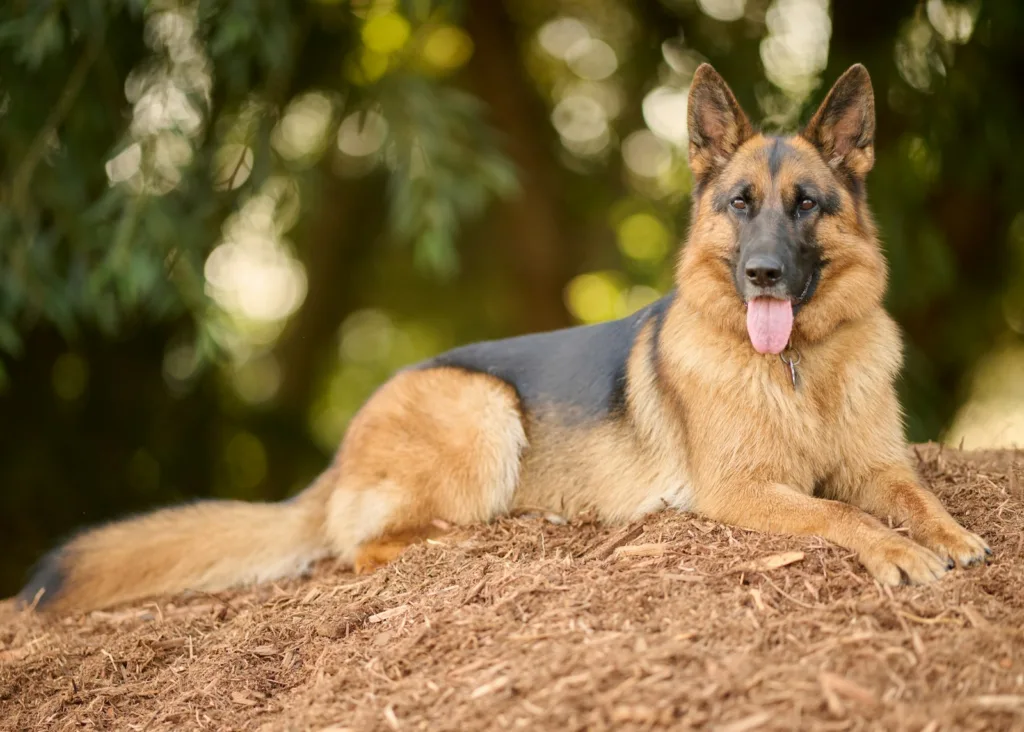
Purebred German Shepherd characteristics described in the AKC standard include a muscular body that is longer than it is tall, a double coat, a bushy tail and ears carried upright when attentive. The standard also describes a confident, approachable dog that may be reserved around unfamiliar people.
These are breeding and show ideals. A puppy’s changing ears, an unusual coat color or a dog’s resemblance to a photograph cannot establish its ancestry. A show fault also does not, by itself, prove that a dog is a mix.
If documented ancestry matters to you, ask for verifiable registration and pedigree records. Keep that question separate from health and household suitability: papers do not tell you how a dog will cope with your children, stairs or work schedule.
Male versus female size
Males are generally larger, but sex is a poor shortcut for choosing personality. Compare the individual dogs’ behavior, handling needs and history rather than assuming a female will be easier or a male more protective.
Our male versus female German Shepherd guide explores that decision. For a growing puppy, use the German Shepherd growth guide to understand monitoring rather than treating a monthly weight chart as a target to chase.
What is a German Shepherd’s temperament like?
The breed is associated with attentiveness, willingness to work and some reserve with strangers. Those qualities can make training rewarding, but the AKC standard’s description is an ideal—not a promise attached to every puppy.
Look for practical evidence: how the dog recovers after a surprise, responds to gentle handling and settles in an ordinary environment. Persistent fear, lunging or guarding needs assessment; calling it “loyalty” does not help the dog or the household.
Can German Shepherds live with children and cats?
Some do well in family homes, but compatibility depends on the individual dog, introductions and supervision. Give children clear rules around eating and resting dogs, and use separation when an adult cannot actively supervise.
Cats need escape routes and protected spaces during introductions. A dog that has lived peacefully with one cat may still chase another. Our guide to German Shepherds and children explains how to assess family fit beyond the breed label.
How much should a German Shepherd eat?
The right amount depends on life stage, body condition, activity and the calories in the food. A cup of one recipe can contain substantially more energy than a cup of another, so a fixed breed-wide scoop count is not reliable.
Choose a complete-and-balanced food suitable for the dog’s life stage; growing puppies need appropriate growth nutrition. The German Shepherd feeding guide explains portions and adjustments, while the adult food guide covers selection criteria.
For a healthy adult, the Dog Food Calculator can provide a starting feeding estimate. Puppies, pregnant dogs and dogs with medical or significant weight concerns need individualized guidance instead.
How much exercise and training do they need?
Plan for daily walks, suitable play, sniffing and short training sessions. PDSA suggests two hours of daily exercise as general breed guidance, but that should not become a compulsory target for a puppy, an older dog or a dog with a health problem.
Teach useful everyday skills alongside activity: coming when called, walking on a loose leash and settling on a mat. A large yard is helpful space; it does not come with an exercise coordinator.
The American Veterinary Society of Animal Behavior recommends reward-based methods. Use food, play and access to enjoyable activities to reinforce desired behavior, and follow a gradual German Shepherd training plan. Pain and intimidation are not prerequisites for handling a strong dog.
How much grooming will you be doing?
Expect to brush several times a week and more often when loose coat builds up. Long-coated dogs may need extra attention where hair tangles, while both coat varieties bring a fairly persistent supply of hair into the home.
Bathing should reflect dirt, skin needs and veterinary advice rather than a rigid weekly schedule. The German Shepherd grooming guide covers coat care alongside nails, ears and teeth. A brush earns its place in the household before a second lint roller does.
What health concerns should owners know about?
Hip and elbow dysplasia deserve attention when evaluating breeding records and planning care. The German Shepherd Dog Club of America’s CHIC requirements include hip and elbow evaluations and a passing club temperament test. A CHIC number means the required results are public; it does not mean every result was normal.
Read the actual results, and ask your veterinarian about the individual dog’s needs. A straight-looking back cannot rule out orthopedic disease. Our German Shepherd hip dysplasia guide explains screening and signs that need assessment.
German Shepherd owners should also recognize possible gastric dilatation-volvulus, or GDV, a stomach emergency. Repeated attempts to vomit without bringing anything up, abdominal swelling, marked restlessness or collapse require immediate veterinary attention. Do not wait for every sign to appear.
What does lifespan research actually tell us?
O’Neill and colleagues’ 2017 study of German Shepherds in UK veterinary care reported a median longevity of 10.3 years. Among recorded deaths, the middle half of ages fell between 8.0 and 12.1 years.
That is a useful real-world research example, with boundaries: it describes a particular UK population and historical records. It does not set a minimum, maximum or expected birthday for your dog. The German Shepherd lifespan guide examines the evidence in more detail.
Are working lines, coat types and colors different breeds?
Working-line and show-line labels describe selection backgrounds within the breed. They should prompt questions about the parents, pedigree and intended work—not assumptions that every dog with the same label has the same energy or temperament.
Coat rules also differ by registry. The FCI recognizes stock and long stock coats with undercoat, while the AKC standard treats an excessively long outer coat as a fault. Our guide to German Shepherd types separates these categories.
Black, sable and other color descriptions are another separate question. Coat color does not establish character or pet suitability; the German Shepherd colors guide explains appearance and show-standard distinctions without turning them into a quality ranking.
Where did German Shepherds originate?
German Shepherds originated in Germany, developed from regional herding dogs. According to the breed’s German parent organization, the Verein für Deutsche Schäferhunde, the club formed on April 22, 1899, with Max von Stephanitz as its first president.
His dog Horand von Grafrath received the first entry in the club’s studbook. That documented example helps explain the breed’s roots in organized working-dog breeding; modern roles and family life came after those herding foundations.
What should you budget for ownership?
The purchase or adoption fee is only the first expense. Budget for food, routine veterinary care, training, equipment and arrangements for care when you are away, plus a realistic way to handle unexpected veterinary bills.
Ask what an initial fee includes and obtain local estimates for ongoing costs. A low purchase price is not a low lifetime budget. Our German Shepherd cost guide separates one-time expenses from the recurring commitments.
Is a German Shepherd right for you?
This breed may suit you if you enjoy teaching a dog, can provide activity and company, and accept that grooming and management are recurring work. Assess your ordinary weekday—not just the weekends when a long hike sounds appealing.
| Potential advantage | Responsibility that comes with it |
|---|---|
| A dog that can enjoy learning and shared activities | Consistent, reward-based teaching and realistic expectations |
| An active companion | A daily routine adapted to the individual dog |
| An alert dog that notices its surroundings | Careful socialization and management around visitors |
| A dog that can participate in family life | Supervision, rest spaces and attention to household compatibility |
| A substantial double coat | Regular grooming and acceptance of shed hair |
Before choosing a dog, describe your real routine to the breeder or rescue. Ask about behavior in the situations that matter to you: visitors, other pets, handling and time alone. Specific answers are more useful than “great temperament.”
Frequently asked questions
How can you tell whether a German Shepherd is purebred?
Appearance alone cannot confirm ancestry. Verifiable pedigree and registration records are more informative than ear shape, coloring or size. “Full-blooded” is commonly used to mean purebred; it is not a separate health or quality certification.
Are German Shepherds good for first-time owners?
They can be, provided the owner has realistic time, training support and a suitable individual dog. Being new to ownership is less informative than whether you can meet the dog’s needs consistently and get help when needed.
Do German Shepherds need a large house?
House size alone does not decide suitability. Access to outdoor activity, a manageable toileting routine, room to rest and the dog’s response to nearby people and animals matter more than square footage by itself.
Does a German Shepherd’s color affect its personality?
Color is not a dependable way to predict personality. Evaluate behavior, history and breeding background separately, and avoid paying a premium based on claims that a particular color guarantees calmness or protection.
What are the main pros and cons of a German Shepherd?
The appeal is an active, attentive dog that can enjoy learning and spending time with its owner. The trade-offs include substantial daily care, shedding, training responsibilities and potential health expenses. Whether that balance works depends on your household and the individual dog.
Research checked October 8, 2026. Health information is general education; individual concerns belong with your veterinarian.


