In this article
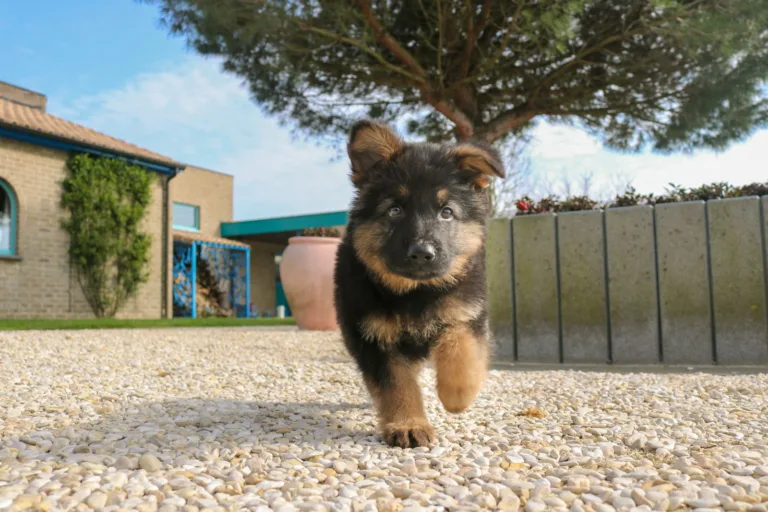
A mini German Shepherd dog is not simply a standard German Shepherd scaled down into an established miniature variety. The label may describe a crossbreed, a smaller individual or a dog with abnormal growth.
Those possibilities have different implications. Ask what is actually being offered before treating small size as a feature.
Mini German Shepherd Dog: Separate the possibilities
| Description | What to investigate |
|---|---|
| Crossbreed marketed as mini | Parentage, expected variation and health |
| Small purebred individual | Pedigree, growth history and condition |
| Puppy with abnormal growth | Veterinary assessment rather than a cosmetic label |
| Shepherd-looking small dog | Identity and individual needs, without visual certainty |
A seller should explain ancestry and health clearly, not use “mini” to avoid both questions.
Pituitary dwarfism is a medical issue
Pituitary dwarfism can affect German Shepherds and requires veterinary assessment. It should not be marketed as a desirable permanent-puppy appearance.
A 2021 published study compared owner reports for 47 dogs with presumed pituitary dwarfism and 94 controls. Its findings came with limitations, including owner reporting, presumptive diagnoses and nonrandom treatment groups.
That is a real research example, not a basis for predicting one dog’s lifespan or prescribing treatment. A small puppy needs appropriate investigation when growth or coat development is concerning.
Crossbreeds do not have one guaranteed adult size
The parents and ancestry can provide context, but a marketing name does not create a standardized growth range. Ask for adult measurements of related dogs and acknowledge uncertainty.
Likewise, crossing breeds does not automatically remove inherited disease or produce a predictable temperament. Evaluate the breeding and individual dog on evidence.
A smaller dog may still have substantial needs
Do not assume reduced size means low exercise, minimal training or easy apartment life. Behavior and health remain individual questions.
The lookalike guide explains why appearance is not ancestry. The growth guide helps distinguish monitoring from chasing a target size.
Questions before buying
Ask for veterinary records, parent information, the basis for the predicted adult size and any explanation for unusual growth. Be cautious if the seller discourages examination or treats medical concerns as proof of rarity.
A puppy’s welfare matters more than preserving the wording of its advertisement.
Frequently asked questions
Is there an official miniature German Shepherd variety?
The standard German Shepherd references used here do not establish one. Ask what the seller means by the name.
How big will a mini German Shepherd get?
There is no universal answer because the label can describe different ancestries and situations.
Is a very small puppy necessarily a dwarf?
No. Several explanations are possible, and diagnosis requires veterinary assessment.
Are mini German Shepherds healthier?
Small size or mixed ancestry does not guarantee health. Review records and the individual’s development.