
In this article
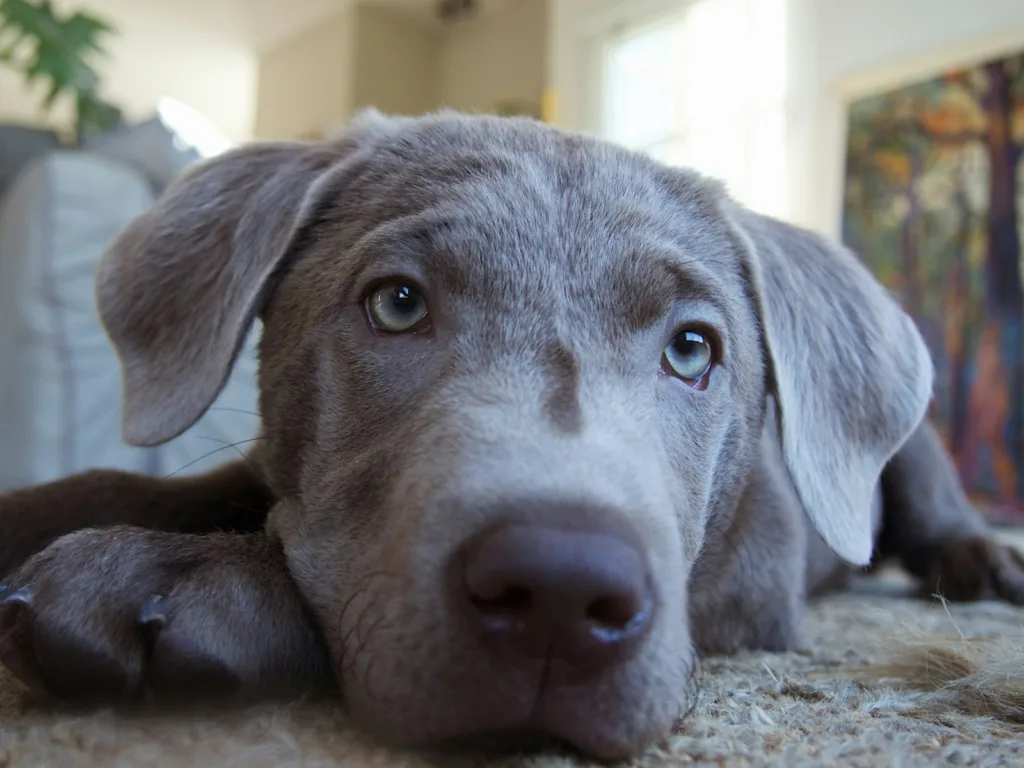
A silver Lab is a dog described as a Labrador with diluted brown pigment, producing a grayish or silvery appearance. “Charcoal” generally refers to diluted black, while “champagne” is used for dilute yellow dogs. None is a fourth color in the AKC Labrador breed standard.
The genetics of dilution, a dog’s recorded pedigree, and a breed club’s position on acceptable color are different questions. Mixing them together makes this topic much louder than it needs to be.
What causes a silver coat?
Variants in the MLPH gene can dilute pigment. UC Davis Veterinary Genetics Laboratory describes recessive dilution variants: dogs generally need two dilution-associated copies for the dilute appearance, while a dog carrying one can appear nondilute.
The familiar D/d notation is a simplified explanation. Laboratories may test more than one variant, and the meaning of a result depends on the variants included.
| Base color description | Common dilute label | What the label tells you |
|---|---|---|
| Chocolate or brown | Silver | A diluted brown appearance |
| Black | Charcoal | A diluted black appearance |
| Yellow | Champagne | A marketing term for a dilute yellow dog; appearance may be subtle |
A very pale yellow dog is not automatically dilute. Ordinary yellow shading can produce a white-looking Labrador without establishing a dilution genotype.
Are silver Labs purebred?
Appearance alone cannot settle an individual dog’s ancestry. The Labrador Retriever Club states that it does not consider silver Labradors purebred and objects to dilute colors. That is the parent club’s position and should be identified as such.
The club also acknowledges in its published discussion that historical Weimaraner crossbreeding cannot be conclusively proved from that discussion alone. A silver coat is not a license to claim that a particular dog has a specific undocumented parent or grandparent.
A coat-color test detects the tested variants. It does not reconstruct every generation of a pedigree or certify compliance with a breed standard. Ask what a seller means by “DNA verified”: parentage testing, a breed-ancestry estimate, and a health panel answer different questions.
Can a silver Lab be AKC registered?
The Labrador Retriever Club reports that AKC has accepted some silver dogs for registration under chocolate. Registration and eligibility under a conformation color standard are not the same thing.
For a specific puppy, inspect the actual paperwork and confirm current recording requirements with the registry. Do not accept a seller’s statement that silver, charcoal, or champagne is an officially recognized additional Labrador color. The standard lists black, yellow, and chocolate.
Do dilute Labs have health problems?
Some dilute dogs develop color dilution alopecia, a condition associated with hair thinning and skin problems. Merck Veterinary Manual includes silver Labradors among affected dogs. This does not mean every silver Lab will develop it, and a reliable prevalence for all silver Labradors should not be invented.
Patchy hair loss, scaling, recurring skin irritation, or infection needs veterinary assessment. A photograph or a dilution result does not diagnose the cause. Dilution testing is not a guarantee of future skin health.
The usual Labrador screening questions still apply. Hips, elbows, eyes, and relevant inherited conditions deserve attention regardless of coat color. See our Labrador health guide for the breeder checklist.
Does silver color change temperament?
There is no sound basis for choosing a silver dog on the promise that the color makes it calmer, smarter, or better with children. Assess the individual, the parents, the breeding program, and the puppy’s early care.
Young puppies can have eye colors that change with maturation. Blue-looking puppy eyes are not proof of permanent adult eye color, ancestry, or health. Ask a veterinarian about eye abnormalities rather than treating them as a premium feature.
Frequently asked questions
What should you check before buying?
Pay for documented care and responsible breeding, not a scarcity story. There is no verified national color-based price schedule that makes a silver premium medically or genetically meaningful.
| Seller claim or situation | Your next question |
|---|---|
| “Rare means more valuable” | What health testing and lifetime support are included? |
| “DNA tested” without documents | Which tests, which laboratory, and which parents? |
| Registration offered as a health guarantee | Where are the orthopedic, eye, and inherited-condition records? |
| A dilution result described as a skin-health guarantee | What is known about skin problems in this family? |
| Pressure to pay immediately | Can you review the contract, identity, and records first? |
Meet the breeder and dogs where feasible, use verifiable records, and avoid sending a deposit because a puppy is supposedly the last available shade. Our Labrador cost guide separates acquisition costs from ongoing care.
Is a silver Labrador the same as a Weimaraner?
No. Weimaraners are a separate breed. Similar coat color does not make two individual dogs the same breed, nor does it resolve the historical dispute about dilute Labradors.
For a less contentious starting point, our Labrador color guide maps official colors, yellow shades, and nonstandard descriptions in one place.
Evidence and review
Key source: UC Davis Veterinary Genetics Laboratory’s dilute-color explanation. Additional checks: Labrador Retriever Club silver statement and dilute update; AKC Labrador standard; Merck Veterinary Manual on inherited skin disorders. Research reviewed September 27, 2026. Breed-club positions are distinguished from genetic findings.


