In this article
- Siamese cat pros and cons at a glance
- What does a Siamese look like?
- What is a “meezer” really like?
- Are males or females better pets?
- How much play and training do they need?
- Can a Siamese stay home alone?
- What does everyday care involve?
- What about children, health and cost?
- Is this the right home for a Siamese?
- FAQs
Siamese cat pros and cons often come from the same trait: these cats tend to want involvement. That can mean an attentive companion who joins your routines, or a demanding housemate when your schedule leaves little room for interaction.
A Siamese may suit you if you enjoy daily play, conversation and a cat who takes an interest in household proceedings. Someone seeking a consistently quiet, largely self-entertaining pet should consider the individual very carefully.
Siamese cat pros and cons at a glance
| Potential advantage | The practical trade-off |
|---|---|
| Often interested in people | Regular interaction takes time |
| Playful and responsive | An unstimulating home can be a poor fit |
| Short, fine coat | Short hair still sheds |
| Often willing to engage in reward-based learning | Learning can include routines you did not intend to teach |
| Distinctive vocal presence | Noise may matter in a shared home |
| Striking pointed appearance | Looks do not establish health or temperament |
The coat is relatively straightforward. The social calendar can be more involved.
What does a Siamese look like?
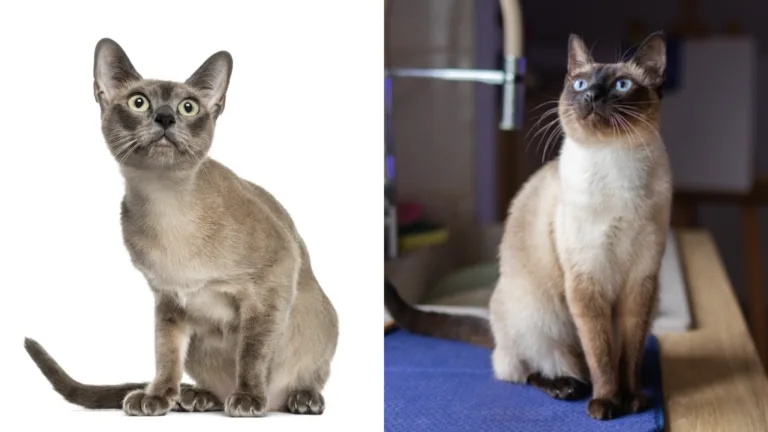
The Cat Fanciers’ Association describes a slender, muscular cat with a short coat, blue eyes and darker points on the face, ears, legs and tail. Modern show lines emphasize a long wedge-shaped head; traditional-looking cats may have a less angular appearance.
Names such as applehead and old-style need context. Our wedge head versus applehead guide explains why an informal appearance label is different from a registered breed.
| Feature | Useful reference |
|---|---|
| Body | Medium, slender and muscular; CFA standard |
| Adult size | TICA describes females around 5–8 lb and males around 8–12 lb |
| Coat | Short and fine; CFA standard |
| Social style | Often interactive; registry descriptions, not a guarantee |
| Grooming | Usually modest coat maintenance, plus ordinary dental and nail care |
| Longevity | Individual outcomes vary; population estimates need context |
The TICA figures are descriptive ranges, not goal weights. The Siamese weight guide explains how body condition matters more than fitting a breed average.
What is a “meezer” really like?
Meezer is an affectionate nickname for a Siamese. It is not a separate type, color or registration category.
Owners and breed registries commonly describe Siamese as social, active and vocal. Those tendencies can be enjoyable when you want a pet who participates, but they do not establish what a particular kitten will become.
Ask an adult cat’s caregiver how it behaves when visitors arrive, when people leave and during quiet evenings. Those observations are more useful than a promise that every Siamese behaves identically.
Are males or females better pets?
Neither sex is a reliable shortcut to a better personality match. Adult males may be larger, but friendliness, confidence and tolerance of handling vary within both sexes.
Consider the individual’s history, reproductive status, health and behavior. Claims that females are uniformly aloof or males uniformly affectionate are too simple to guide an adoption.
How much play and training do they need?
Offer several opportunities for interactive play rather than expecting one toy to provide a full day’s entertainment. Rotate safe toys, provide scratching surfaces and make resting places available above floor level where practical.
Reward a behavior you want, such as approaching a mat or entering a carrier, in small achievable steps. Keep sessions short enough that the cat remains interested. The carrier should not appear only when something unpleasant is about to happen; cats notice patterns with inconvenient accuracy.
Biting during play is a reason to change the interaction, not to punish the cat. Keep hands out of wrestling games, offer an appropriate toy and investigate pain or distress if behavior changes.
Can a Siamese stay home alone?
Some can settle during ordinary absences when their needs are met. There is no universal number of hours that makes every Siamese comfortable.
Age, health, previous experience and the home setup all matter. Kittens need more supervision, and a cat showing persistent distress deserves attention to its environment and health.
A second cat is not an automatic solution. Read about introducing Siamese cats to other pets before bringing home company for a cat who may prefer its current arrangement.
What does everyday care involve?
Feed an appropriate complete diet, measure portions and monitor body condition. Breed branding on a bag is not a nutritional requirement; our Siamese feeding guide explains selection and portions.
For a healthy adult, the cat food calculator can provide a starting estimate. Kittens, pregnant or nursing cats and cats with medical conditions need a different assessment.
Brush gently as needed, introduce toothbrushing gradually and check nails and skin. Short fur is convenient, but it does not make Siamese hypoallergenic.
What about children, health and cost?
A respectful child and a comfortable cat may form a good relationship. Teach children to let the cat approach, support its body and leave it alone when it retreats. No breed makes rough handling acceptable.
Health considerations include inherited retinal disease and documented familial liver disease, alongside problems that affect cats generally. Discuss family history and relevant screening rather than expecting a broad “health guarantee” to answer every question.
Acquisition is only part of the budget. Our Siamese cost guide separates dated advertised prices from recurring care and clearly labeled budgeting assumptions.
Is this the right home for a Siamese?
Picture an ordinary weekday, not the first weekend with a kitten. Can you provide interaction, maintain feeding and cleaning routines, afford veterinary care and accommodate a cat whose voice may carry?
The CFA Siamese profile and standard provide a useful breed reference. For the final decision, meet the actual cat and ask specific questions about its behavior.
FAQs
Are Siamese cats smart?
Many engage readily with play and reward-based learning. “Smartest breed” rankings are less useful than finding activities your individual cat enjoys.
Do Siamese cats like water?
Some investigate taps or water play; others avoid it. Do not force swimming or bathing because of a breed story.
Are male Siamese cats rare?
No evidence reviewed supports treating an ordinary male Siamese as a rare purchase. Ask what a seller means and what records support the claim.
Are Siamese suitable for first-time owners?
They can be, when the owner wants an interactive cat and prepares for daily care. First-time status matters less than expectations, resources and the individual match.
Is indoor living suitable?
An enriched indoor home can offer play, climbing, scratching and companionship. Indoor living still requires active care; closing the door is not an enrichment plan.