In this article
A lynx point Ragdoll has tabby markings in its colored points. “Lynx” describes those markings; it does not mean the cat is part wild lynx, a separate breed or a particular base color.
That is why a cat can be a seal lynx mitted Ragdoll or a blue lynx bicolor Ragdoll. Each word contributes a different piece of the description. The name looks lengthy because it is doing several jobs.
What does a lynx point Ragdoll look like?
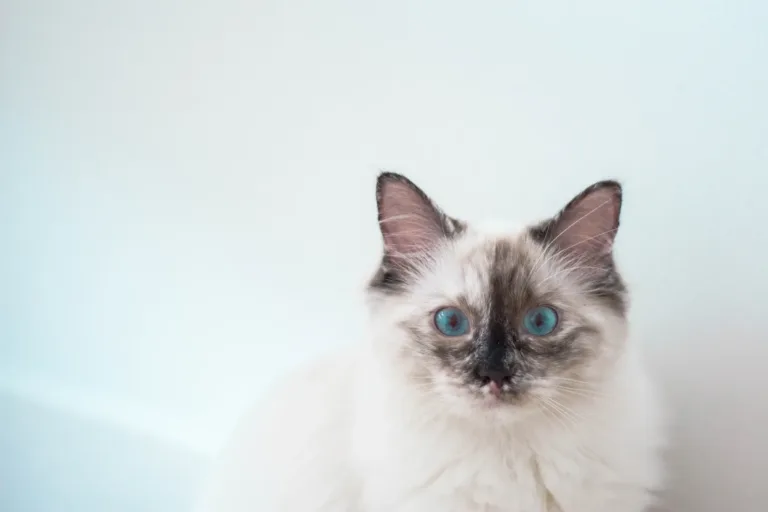
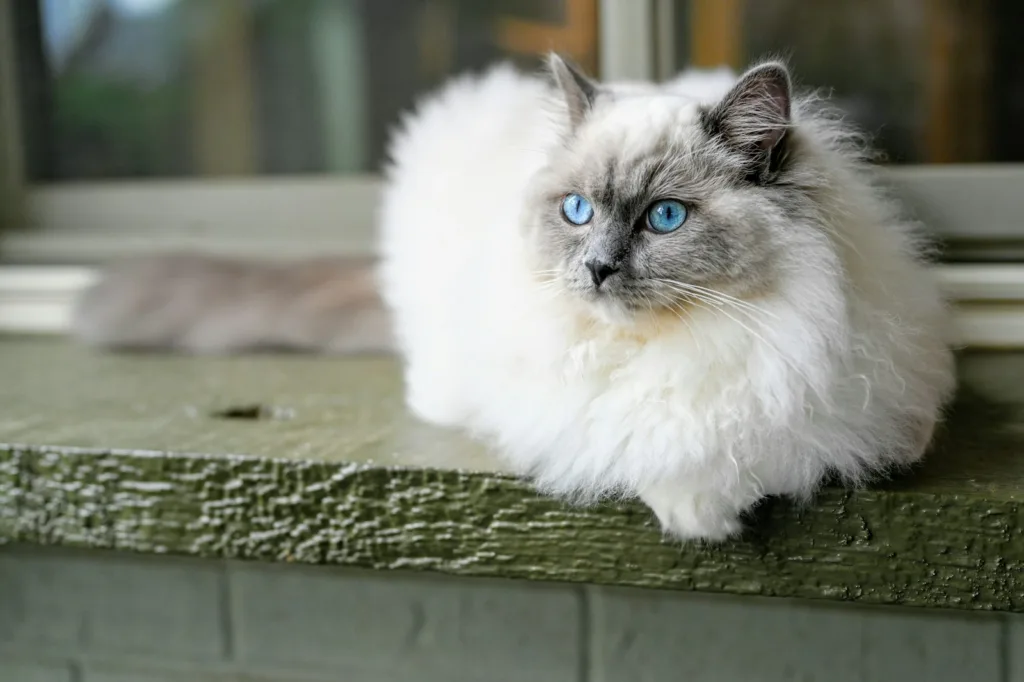
Look for striping in the colored areas, which may include facial lines, bands on the legs and rings on the tail. A forehead marking resembling an M is a familiar tabby feature, but it may be faint, immature or partly covered by white.
The CFA Ragdoll standard describes lynx points within its color and pattern system. Color, tabby markings and white distribution belong to different layers of that system.
Use more than one visual clue. A single striped-looking shadow beside the nose is not a useful ancestry test, and a white forehead does not necessarily rule out lynx elsewhere on the cat.
How do seal lynx and blue lynx differ?
Seal and blue describe the underlying point color. Lynx tells you that tabby markings are also present.
| Description | Color and markings | What the remaining words tell you |
|---|---|---|
| Seal lynx point | Dark brown-based tabby points | White-pattern terminology still needs checking |
| Blue lynx point | Blue-gray tabby points | Blue is a coat-color term, not a claim of bright blue fur |
| Seal lynx mitted | Seal tabby points with mitted white markings | The white pattern is mitted |
| Blue lynx bicolor | Blue tabby points with bicolor white markings | White can interrupt the visible facial striping |
| Seal lynx bicolor | Seal tabby points with bicolor white markings | The base color remains seal |
The seal point guide covers the darker color family. The blue Ragdoll guide explains blue in more detail.
Descriptions may place the words in a different order. “Blue bicolor lynx” and “blue lynx bicolor” may be intended to describe the same combination, but the registration record is the useful place to settle a breeder’s formal wording.
Can a lynx Ragdoll be mitted or bicolor?
Yes. Lynx markings and white pattern are not competing options. A cat does not have to choose between stripes and white paws.
Consider a worked example: a kitten has blue-gray tabby points and the white distribution described by its registry as bicolor. “Blue lynx bicolor” combines those observations. It is an example of how the terminology works, not a diagnosis of an unseen kitten.
In another combination, a seal lynx cat has mitted white markings. The result is seal lynx mitted, rather than a different brown color.
Our mitted versus bicolor comparison explains why white feet alone do not settle the entire pattern label.
Do lynx markings change as kittens grow?
Pointed kitten coats develop color over time. Early photographs may show much less contrast than later ones, so fine facial or leg markings can be difficult to evaluate in a young kitten.
Temperature-sensitive pigment production helps explain the pointed distribution. It does not give an owner a reliable calendar for the exact day every stripe will become clear.
Ask for dated photographs in ordinary light and the kitten’s registered description. Compare the same areas across pictures rather than treating a strongly edited adult photograph as a guaranteed preview.
A good question is, “Which features support this label now, and which are still developing?” It is much more useful than asking someone to promise the finished face at eight weeks.
Are tabby Ragdolls real?
Lynx-point Ragdolls are recognized in the reviewed standards. However, “tabby” by itself is a broad coat description found in many cats, including domestic cats with no documented Ragdoll ancestry.
A long coat, blue eyes and stripes can suggest a resemblance. They do not establish parentage. For that, check the pedigree and registration records and make sure the records identify the actual animal.
The Ragdoll mix guide explains the difference between a documented cross, a shelter’s appearance-based label and a breed-similarity DNA result.
Does the lynx pattern affect temperament or care?
The research reviewed for this guide does not establish a separate lynx Ragdoll personality. A striped face is not evidence that the cat will be more playful, more affectionate or more tolerant of brushing.
Ask how the individual cat responds to handling, unfamiliar people, other pets and routine grooming. For a kitten, ask what gentle handling and social exposure have actually taken place.
Coat maintenance also depends on the coat in front of you. Check common friction areas for tangles and build a comfortable routine using the Ragdoll grooming guide.
There is no special lynx-point diet. Age, body condition, health and the food’s nutritional adequacy matter much more than whether the tail has rings.
Frequently asked questions
What is a lynx point Ragdoll?
It is a Ragdoll with tabby markings on its colored points. Lynx is a pattern description, not a reference to a wild-cat cross.
How do I know whether my Ragdoll is lynx?
Look for several consistent tabby features in the colored areas and check the registration description. Young age, pale coloring and white markings can make visual assessment harder.
Must every lynx Ragdoll have a visible M on its forehead?
No. That marking may be difficult to see or interrupted by white. Evaluate the overall pattern rather than requiring one visible letter.
Is a blue lynx bicolor the same as a blue bicolor?
Both descriptions can refer to a blue bicolor cat, but “lynx” adds the presence of tabby markings. Without that word, the description does not specify lynx markings.