In this article
- Where are Siamese cats from—and what does “Siamese” mean?
- What do old manuscripts establish?
- A short timeline with different kinds of evidence
- Were they exclusively royal or temple cats?
- How did appearance change?
- Why do color names differ between countries?
- What can history tell you about a pet today?
- FAQs
Where are Siamese cats from? Their origin is associated with Thailand, historically known as Siam. Their later development as registered show cats also reflects breeding and classification outside Thailand.
The history is old, but not every attractive story is documented. A dated manuscript, an imported cat and a modern breed standard each tell a different part of it.
Where are Siamese cats from—and what does “Siamese” mean?
The name points to Siam, the historical name associated with Thailand. It does not refer to Egypt, despite the ancient-looking elegance sometimes used in modern advertisements.
A cat’s cultural history and the history of a standardized pedigree breed are related but not identical. Modern registration categories should not be projected unchanged across centuries.
For current type distinctions, our wedge head and applehead guide separates informal appearance labels from registered breeds.
What do old manuscripts establish?
Thai cat manuscripts document a tradition of describing and illustrating cats. The date of a surviving copy must be distinguished from the possible age of the tradition it represents.
The British Library catalog record for Or 16797 describes a nineteenth-century illustrated cat treatise. It is a concrete object with an archival record, not proof that the modern Siamese breed began in a particular year centuries earlier.
That distinction matters when an article claims “the first Siamese was recorded in 1350.” An older literary tradition does not automatically date every surviving manuscript or verify an unbroken modern pedigree.
A short timeline with different kinds of evidence
| Event | What the source supports |
|---|---|
| Thai literary and cultural tradition | Historical descriptions of cats, with dating requiring care |
| Nineteenth-century manuscript | A surviving cataloged object, such as Or 16797 |
| 1871 Crystal Palace show | Early Western show appearance described by TICA |
| 1879 American arrival | TICA’s account of the cat associated with the Hayes household |
| 1884 Pho and Mia | An important imported breeding pair described in GCCF history |
| Modern registry standards | Formal definitions that differ between organizations |
The 1884 breeding pair should not be called the first European appearance when an earlier show record is also being discussed. “First” needs a specific event attached to it.
Were they exclusively royal or temple cats?
Royal and temple associations appear frequently in popular histories. The strongest version—only royalty could own them, everywhere and throughout their history—requires evidence that was not established in this research.
Legends can be discussed as legends. They should not quietly become factual explanations for every physical trait or behavior.
A cat does not need an invented palace job to be interesting. The documented spread from Thailand into Western breeding programs is already a substantial story.
How did appearance change?
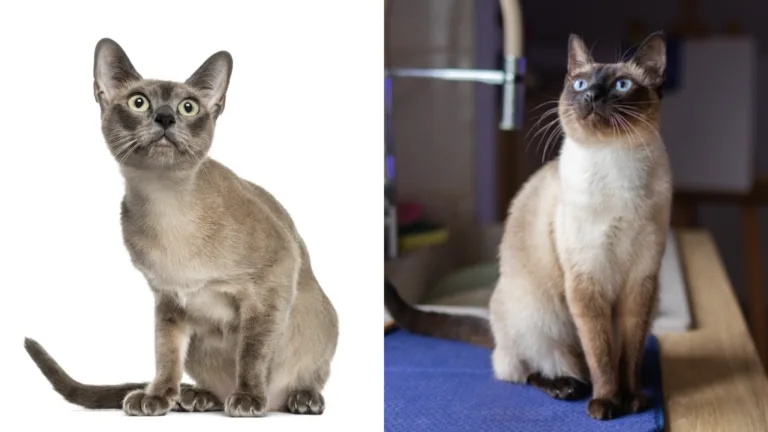
Modern show standards describe particular proportions, including the long wedge type familiar in many Siamese photographs. Traditional-looking cats may have less angular features.
TICA recognizes the Thai as a breed preserving an old-style type. That does not mean every rounder-headed pointed cat is automatically a registered Thai.
Historical change is better explained through standards and records than by declaring one current look “real” and every other look false.
Why do color names differ between countries?
Registries developed their own classifications. A nonclassic pointed color may be included within Siamese in one organization and placed in a related breed category in another.
Our Siamese color chart explains that distinction. A registry disagreement is not a reason to accuse an owner of misidentifying a cat when the underlying standard differs.
What can history tell you about a pet today?
History helps explain names and development. It does not tell you whether an individual cat likes children, accepts another pet or will tolerate long absences.
For those decisions, use the breed guide and the actual cat’s behavior. Heritage supplies context, not a household guarantee.
FAQs
Are Siamese cats from Egypt?
The breed’s origin is associated with Thailand, formerly Siam. An Egyptian origin is not supported by the evidence used here.
When did Siamese cats come to America?
TICA’s historical account identifies an 1879 arrival associated with the Hayes household. Keep the attribution rather than expanding it into claims about every undocumented earlier cat.
How old is the breed?
Its Thai background predates modern Western registration, but assigning a single exact age oversimplifies the evidence. Literary history and a modern pedigree standard are different measures.
Are all applehead cats the original Siamese?
No. Applehead is an informal appearance term and does not certify ancestry or historical authenticity.
Does a celebration date establish breed history?
No. A modern observance is different from an archival event. An unsupported origin story for a calendar celebration should not be used as historical evidence.