In this article
- What makes a Cat tree for a Maine Coon suitable?
- How big should the platforms be?
- How much weight should a Maine Coon cat tree hold?
- Solid wood vs engineered wood
- What should the scratching posts be like?
- A practical cat-tree comparison framework
- Where should you put the cat tree?
- Does a Maine Coon need a tall tree?
- When should you replace a cat tree?
- FAQs
- Related Maine Coon guides
- Sources and review
The best cat tree for a Maine Coon is not necessarily the tallest one. It is the one with large usable platforms, a wide stable base, strong joints, sturdy scratching posts and weight guidance that comfortably accommodates your cat.
“XL” is marketing. Dimensions are evidence.
What makes a Cat tree for a Maine Coon suitable?
A full-grown Maine Coon puts more leverage on a tower than a smaller cat because the breed is both heavy and long. A platform can technically support 20 lb and still feel cramped if the cat’s hips and shoulders hang off both sides.
Prioritize broad platforms, a heavy base, thick posts with solid connections, manufacturer load guidance, durable scratching surfaces, secure wall anchoring on tall units, and washable beds or covers where practical.
How big should the platforms be?
There is no veterinary standard saying every Maine Coon perch must be exactly 20 inches wide. Use your own cat’s body length and sleeping posture.
Measure the space your cat occupies when curled and when lying on its side. A platform that supports the whole torso is more useful than a tiny shelf attached to an impressive tower.
How much weight should a Maine Coon cat tree hold?
Use a meaningful safety margin above the cat’s current weight. If a cat weighs 18 lb, a platform rated only to 18 lb leaves little margin for jumping forces, wear or a heavier adult weight.
Manufacturers calculate capacities differently, so compare per-platform ratings, construction and anchoring instructions. Recheck bolts periodically; repeated jumping can loosen hardware.
Solid wood vs engineered wood
| Construction | Advantages | Tradeoffs |
|---|---|---|
| Solid wood | Heavy, durable, often repairable | Usually expensive and heavy to move |
| Quality plywood | Strong for its weight, stable | Quality varies by thickness and joinery |
| MDF/particleboard | Affordable, common | Can weaken if moisture or fasteners damage it |
| Lightweight cardboard-core structures | Easy to move | Often a poor match for a very large, forceful cat |
Material alone does not decide strength. A well-built plywood tower can outperform a badly joined “solid wood” product.
What should the scratching posts be like?
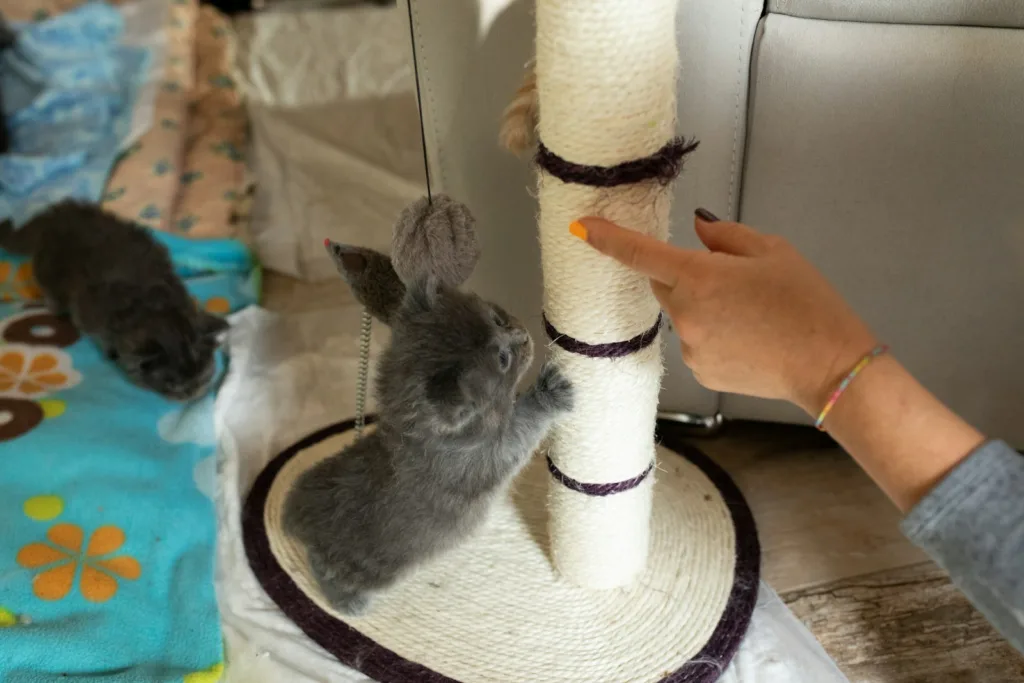
Maine Coons benefit from posts tall enough for a full-body stretch. Thick, tightly wrapped sisal posts tend to tolerate powerful scratching better than narrow decorative posts.
Watch where your cat naturally scratches. Some prefer vertical sisal, others horizontal cardboard, and many are happy to maintain a diversified scratching portfolio.
A practical cat-tree comparison framework
| Specification | What to record |
|---|---|
| Overall height | Floor to highest perch |
| Base footprint | Width × depth |
| Largest usable platform | Actual sleeping surface |
| Per-platform capacity | Manufacturer-stated limit |
| Post diameter | Larger/stiffer can reduce flex |
| Wall anchor included? | Important on tall units |
| Bed/hammock dimensions | Check against your cat’s body |
| Replacement parts | Can extend useful life |
| Cover cleaning | Removable/washable is convenient |
Use the actual model’s current manual and specifications when comparing products. A load limit for the whole tree may differ from the limit for a hammock or individual perch; ask the manufacturer if the rating is unclear.
Where should you put the cat tree?
Place it where the cat has a reason to use it: near a window, in a social room, or close to a preferred resting area. A magnificent tower in a basement corner may lose to the back of the sofa every time.
Avoid unstable rugs or uneven flooring, and use the wall anchor when the manufacturer provides one.
Does a Maine Coon need a tall tree?
Not necessarily. Vertical territory is useful, but a cat with arthritis, a disability or simply a preference for lower surfaces may be happier with wide stepped platforms than a very tall tower.
Kittens also need manageable distances between levels. Bigger jumps are not automatically better enrichment.
When should you replace a cat tree?
Replace or repair a tree when posts crack, fasteners pull out, platforms sag, joints loosen or the base becomes unstable. Frayed coverings can expose staples or loose material a cat might swallow. Block access until damaged furniture can be repaired safely or replaced.
Check the tree after moving house or disassembling it; reassembly is when missing hardware likes to reveal itself.
FAQs
What size cat tree does a Maine Coon need?
Choose based on the adult cat’s body length and weight. Look for generous platforms, a broad base and clearly stated capacity rather than relying on “large cat” labels.
Should a Maine Coon cat tree be anchored to the wall?
Tall trees are safer when anchored according to manufacturer instructions, especially with a large cat that launches onto upper platforms at speed.
Are hammocks good for Maine Coons?
They can be if the hammock dimensions and attachment points are rated for the cat’s weight and body size. Small suspended bowls often become the limiting feature.
Is solid wood necessary?
No, but sturdy construction is. Quality plywood or other engineered materials can work well when dimensions, joinery and fasteners are appropriate.
Related Maine Coon guides
- Maine Coon Size and Weight
- Litter Box for a Maine Coon
- Maine Coon Temperament and Personality
- Maine Coon breed and care guide
Sources and review
Key reference: AAFP/ISFM: Feline environmental needs guidelines.
Additional source notes: Cat Fanciers’ Association, Maine Coon size/build standard; The International Cat Association, Maine Coon breed information; Product specifications should be rechecked immediately before any model-specific recommendation is published..
Editorial fact-check: September 29, 2026.