In this article
- Maine Coon at a glance
- Origin: the raccoon myth and real history
- What is a Maine Coon’s temperament like?
- How big do Maine Coons get?
- How should you feed a Maine Coon?
- How much grooming does a Maine Coon need?
- Maine Coon health and lifespan
- What does a Maine Coon cost to own?
- Is a Maine Coon right for you?
- Maine Coon care checklist
- FAQs
- Explore the Maine Coon guides
- Sources and review
A Maine Coon is a lot of cat, but not simply because of the scale. The breed matures slowly, carries a semi-long coat, tends to be social without being relentlessly needy, and benefits from equipment sized for an adult cat rather than a standard 9-pound house cat. Good Maine Coon care is mostly ordinary cat care done thoughtfully.
Feed for body condition, brush often enough to prevent mats, provide daily play and climbing, keep up with dental and preventive veterinary care, and understand the breed’s inherited health risks before buying or breeding one.
Maine Coon at a glance
| Trait | Practical guide | Evidence note |
|---|---|---|
| Origin | United States; strongly associated with Maine and New England | CFA and TICA breed histories |
| Adult size | Large; published ranges vary by registry and population | TICA lists females about 9–13 lb and males about 13–18 lb |
| Maturity | Slow | TICA says full maturity is typically around 4 years |
| Coat | Semi-long, shaggy, weather-resistant appearance | CFA/TICA standards |
| Temperament | Often gentle, social, playful and people-oriented | Breed descriptions; individuals vary |
| Grooming | Usually several short brushing/combing sessions each week | Practical coat care; increase during shedding or matting |
| Main inherited concerns | HCM, spinal muscular atrophy; hip dysplasia is also screened in breeding programs | Veterinary genetics and orthopedic screening sources |
| Typical lifespan | No single number fits every population | TICA lists 12.5+ years; a 2024 UK VetCompass life table estimated 9.71 years at age 0 |
Origin: the raccoon myth and real history
Maine Coons are domestic cats. They are not part raccoon, and cats cannot breed with raccoons. The familiar myth probably survived because the breed’s long, ringed-looking tail can resemble a raccoon’s and because the name invites the comparison.
The better-supported story is less theatrical. Maine Coons developed as a North American landrace from domestic cats in New England. Genetic work on cat breeds supports the broader point that modern breeds arose from domestic-cat populations rather than exotic interspecies crosses.
Are Maine Coons part raccoon?
No. A cat-raccoon hybrid is biologically implausible, and there is no evidence that Maine Coons descend from raccoons. The tail is impressive; the family tree is still feline.
What is a Maine Coon’s temperament like?
Maine Coons are commonly described as gentle, friendly and curious. Many want to be near people and participate in household activity, but they are not guaranteed lap cats. Some prefer sitting beside you to sitting on you.
Breed tendencies matter, but personality also reflects genetics within the line, early socialization, health, age and the individual cat. A quiet Maine Coon and a bold domestic shorthair can both exist without violating any rule of nature.
How big do Maine Coons get?
Maine Coons are one of the largest established domestic cat breeds, but healthy size is not the same thing as maximum weight. TICA’s breed introduction gives average adult ranges of 9–13 lb for females and 13–18 lb for males, while CFA notes that mature males can reach or exceed 20 lb. Body condition matters more than reaching a breed-average number.
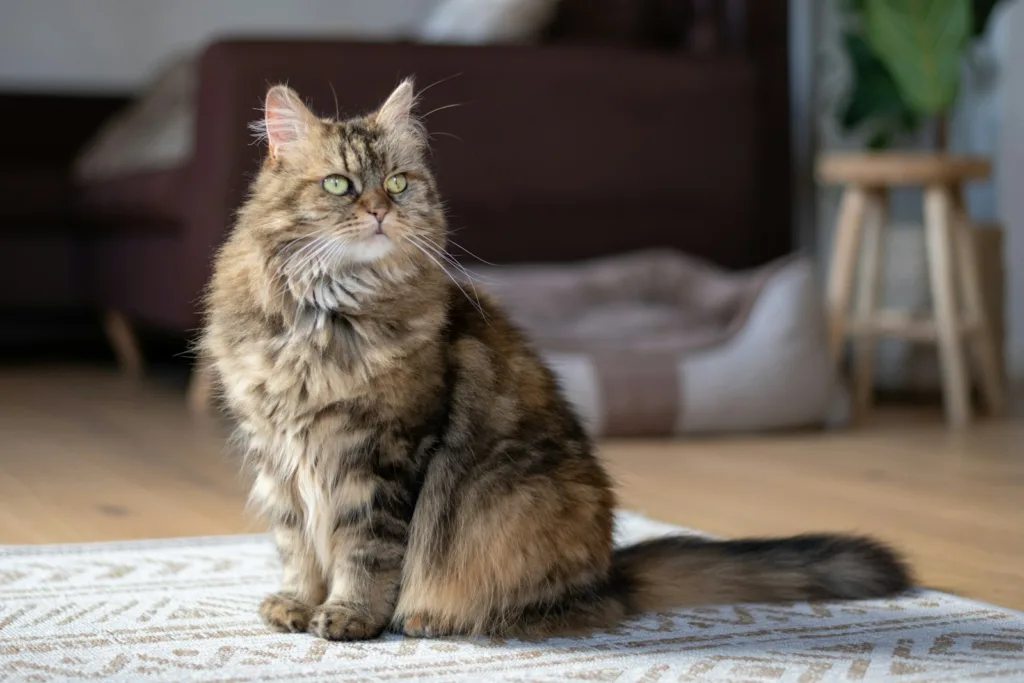
They are also long-bodied, with a large frame and a long tail. Because the breed may continue filling out for several years, a young adult can look lankier than the finished cat it becomes.
Read our Maine Coon Size and Weight for the details.
How should you feed a Maine Coon?
Feed a complete and balanced cat food appropriate for the cat’s life stage, then adjust portions to maintain a healthy body condition. Large breed does not mean unlimited calories. Neutering, indoor living, activity, age and individual metabolism can change energy needs substantially.
For an adult, calories are a better starting point than “cups” because different foods pack very different energy into the same volume. Kittens need food formulated for growth and should not be put on an adult weight-control plan unless a veterinarian directs it.
Read our How Much Should a Maine Coon Eat? for the details.
How much grooming does a Maine Coon need?
Most Maine Coons benefit from combing or brushing two or three times a week, with more attention when the coat is shedding heavily or starting to tangle. Focus on friction points such as the armpits, belly, chest, britches and behind the ears.
A wide-tooth comb is useful for finding tangles down near the skin. A slicker can help with loose coat, but it should not be used as a substitute for checking the full depth of a thick coat. Severe mats that sit close to skin are safer for a professional groomer or veterinary team to remove.
Read our Maine Coon Grooming for the details.
Maine Coon health and lifespan
The breed has documented inherited risk for hypertrophic cardiomyopathy, or HCM. A known MYBPC3 A31P variant raises risk, but a negative DNA test does not rule out all HCM. Echocardiography remains the key clinical test when heart disease is suspected or screening is recommended.
Spinal muscular atrophy is another inherited condition with DNA testing available. Responsible breeding programs may also screen hips because hip dysplasia occurs in Maine Coons.
Lifespan figures depend heavily on how they are measured. TICA lists life expectancy as 12.5+ years. A Swedish insured-cat study found that 54% of Maine Coons in its later study period were still alive at 12.5 years, while a 2024 UK VetCompass life table estimated life expectancy at birth at 9.71 years. Those are different populations and methods, not a contradiction that can be solved by picking the nicest number.
Read our Maine Coon Lifespan and Health Problems for the details.
What does a Maine Coon cost to own?
Breeder prices can run into several thousand dollars. For example, Sweet Giants Maine Coons advertised a starting price of $3,900 for pet kittens from its standard line when checked on September 29, 2026. That is one seller’s advertised starting price, not a national average or an endorsement. Verify health screening, the contract and what is included before paying.
Ongoing costs can also run higher than for a smaller cat because large carriers, litter boxes, trees and food portions may cost more. Insurance premiums and veterinary costs vary by region and cat.
Read our How Much Does a Maine Coon Cost? for the details.
Is a Maine Coon right for you?
| Household question | Fit | What to consider |
|---|---|---|
| Children | Often good | Teach respectful handling; supervise young children |
| Cat-friendly dogs | Often good | Use gradual introductions |
| Other cats | Often good | Personality and introduction matter |
| Small apartment | Possible | Provide vertical space, play and appropriately large equipment |
| Allergy household | Poor choice if cat-allergic | Maine Coons are not hypoallergenic |
| Long hours alone | Depends | Many are social; enrichment and companionship matter |
| Low-grooming home | Not ideal | The coat needs regular attention |
Are Maine Coons high maintenance?
They are moderate-maintenance rather than effortless. The coat, large equipment, daily play and breed-specific health screening add work, but routine care is manageable for owners who plan for it.
Maine Coon cat shows
Both CFA and TICA recognize the Maine Coon. Show standards describe a large, rectangular cat with a substantial frame, shaggy coat, large ears and a long flowing tail. Show judging is about conformity to a written standard, not simply finding the heaviest cat in the room.
Maine Coon pregnancy and litter size
Pregnancy and litter size vary from cat to cat, and breeding should be handled as a health and genetics project rather than a way to produce a casual litter. Breeding cats should have appropriate genetic and veterinary screening, and pregnant cats need individualized veterinary care.
Maine Coon care checklist
| Frequency | Care task |
|---|---|
| Daily | Fresh water, measured food, litter-box cleaning, play and social interaction |
| 2–3 times weekly | Comb/brush coat and check for mats |
| Weekly | Check nails, ears, skin, eyes and body condition |
| Monthly | Review weight trend; inspect equipment for wear or instability |
| Regular veterinary schedule | Vaccination/preventive care, dental assessment, health screening as indicated |
FAQs
How do you take care of a Maine Coon?
Feed a complete diet in measured portions, provide daily play and climbing opportunities, groom the coat several times a week, use large sturdy equipment, and keep up with preventive veterinary care and breed-relevant screening.
Where do Maine Coons come from?
The breed developed in the United States and is historically linked to Maine and the wider New England region.
Can a cat and a raccoon breed?
No. Maine Coons are domestic cats, not cat-raccoon hybrids.
Are Maine Coons good family cats?
Many are friendly and tolerant, but no breed guarantees a particular personality. Early socialization, respectful handling and the individual cat matter.
Explore the Maine Coon guides
- Maine Coon Feeding Chart: Calories, Cans and Cups
- How Much Does a Maine Coon Cost? Prices and Budget
- Maine Coon Size and Weight: Healthy Adult Ranges
- Maine Coon Growth Chart: Milestones and Mature Size
- Calico and Tortie Maine Coons: Colors and Genetics
- Maine Coon Colors and Patterns Explained
- Is My Cat a Maine Coon? Traits, Pedigrees and DNA Tests
- Are Maine Coons Hypoallergenic? Allergy Facts
- Maine Coon Mix: Traits, Size and Ancestry Limits
- Black Maine Coon: Solid Black, Smoke and Coat Changes
- Maine Coon Lifespan and Health: What Research Shows
- Maine Coon Grooming: Brushing, Mats, Baths and Nails
- Silver Maine Coon: Tabby, Shaded and Smoke Differences
- Black Smoke Maine Coon: Coat, Genetics and Changes
- White Maine Coon: Eye Colors, Hearing and Genetics
- Maine Coon Features: Tail, Ears, Eyes and Paws
- Maine Coon Personality: Family Life and Daily Needs
- Maine Coon vs Siberian: Size, Care and Personality
- Maine Coon Litter Box: Size, Access and Setup
- European vs American Maine Coon: Labels Explained
- Tabby Maine Coon: Brown, Classic, Mackerel and Ticked
- Best Food for Maine Coon Cats: How to Choose
- Polydactyl Maine Coon: Extra Toes, Genetics and Care
- How to Find a Maine Coon Breeder or Rescue
- Orange Maine Coon: Red, Cream and Color Genetics
- Maine Coon vs Norwegian Forest Cat: Key Differences
- Cat Tree for a Maine Coon: Size and Stability
- Maine Coon vs Ragdoll: Personality, Care and Health
- Mini Maine Coon: Small Cats and Marketing Claims
- 300+ Maine Coon Names: Ideas by Style and Color
Sources and review
Key reference: Cat Fanciers’ Association: Maine Coon profile and breed standard.
Additional source notes: TICA, Maine Coon; CFA, Maine Coon breed standards; Cornell Feline Health Center, Hypertrophic Cardiomyopathy; Teng et al., 2024, UK cat life tables; Egenvall et al., Swedish insured-cat mortality; 2021 AAHA/AAFP Feline Life Stage Guidelines.
Editorial fact-check: September 29, 2026.