In this article
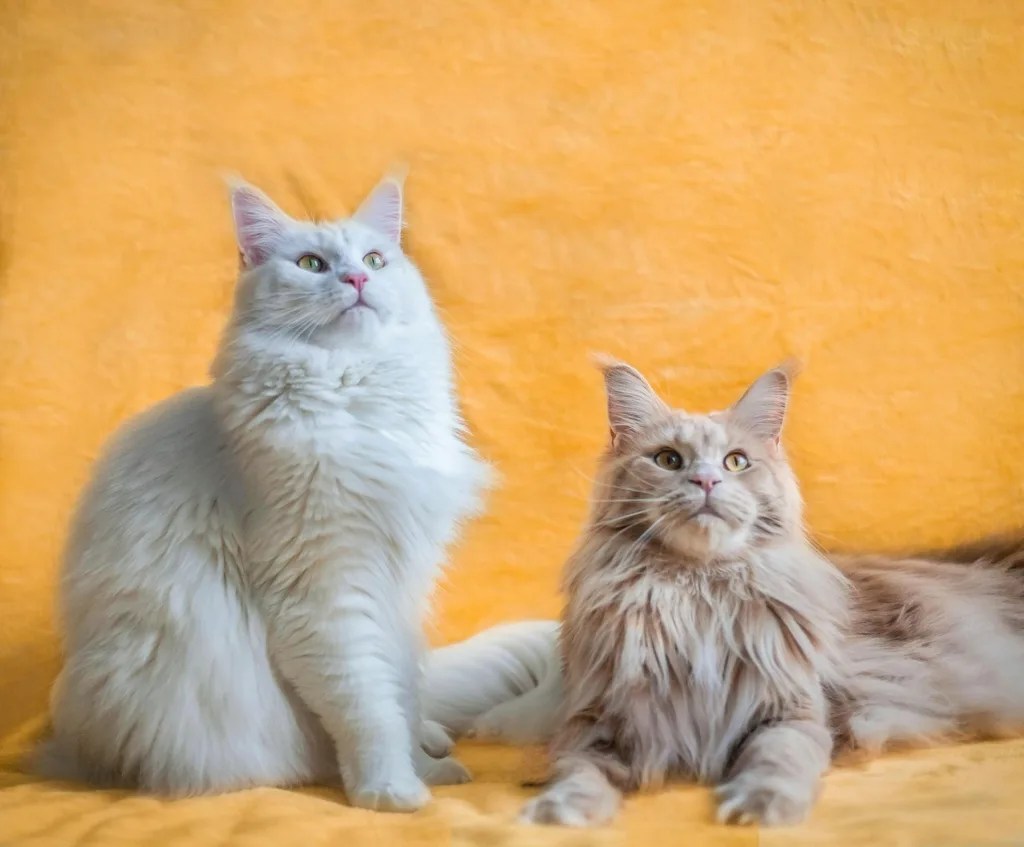
A solid white Maine Coon can have blue, gold/copper, greenish or odd-colored eyes depending on registry classification and genetics. The important health fact is that dominant white pigmentation is associated with congenital sensorineural deafness in cats, with blue-eyed white cats at higher risk in several studies.
That does not mean every white Maine Coon is deaf. Hearing should be tested, not guessed from eye color.
What makes a Maine Coon white?
Dominant white can mask the cat’s underlying color and pattern, leaving the coat solid white. The cat may genetically carry black, red, tabby or other color information that is simply hidden by the white phenotype.
This is different from albinism, which involves a different pigment pathway.
Blue, gold, green and odd eyes
White cats can have two blue eyes, two non-blue eyes, or one of each. Eye color is visually useful but should not be used as a hearing test.
CFA color codes recognize blue-eyed, gold-eyed and odd-eyed white Maine Coons.
Are white Maine Coons deaf?
Some are, some are not. In a 2019 UK study of 132 solid-white purebred kittens across several breeds, congenital sensorineural deafness occurred in 30.3% overall. White kittens with at least one blue iris had higher odds of deafness than white kittens without blue irises.
The Maine Coon subgroup in that study was small—18 kittens—so its breed-specific percentage should not be treated as a universal Maine Coon risk estimate. The broader result is more useful: white pigmentation raises risk, blue eyes can raise it further, and individual hearing needs objective testing.
BAER hearing testing
BAER, or brainstem auditory evoked response, measures the nervous system’s response to sound. It can determine whether a cat hears normally in both ears, is deaf in one ear, or is deaf in both.
BAER testing can identify deafness in one ear as well as both. Reactions to clapping or other home sounds cannot reliably establish hearing in each ear.
White kitten “head smudge” and hidden color
Some white kittens are born with a small colored patch on the head that fades as they mature. Historically, such patches have been described as clues to the underlying masked color.
Pedigree color genetics provides more reliable breeding information than trying to reverse-engineer a faded kitten spot years later.
White vs albino Maine Coon
| Feature | Dominant white | Albino |
|---|---|---|
| Coat | White because pigment is masked/suppressed | White/very pale from albinism pathway |
| Underlying color genes | Can be present but hidden | Different pigment mechanism |
| Eye color | Blue, gold/copper, greenish, odd | Often very pale/blue depending on type |
| Deafness association | Documented with dominant white | Different mechanism; do not assume same risk |
Sun and skin care
White ears and noses have less protective pigment. Cats with lightly pigmented skin can be more vulnerable to ultraviolet damage, especially with intense sun exposure.
Indoor living and limiting prolonged strong sun exposure are sensible. Any persistent crusting, sores or pigment changes on the ears or nose deserve veterinary evaluation.
FAQs
Are white Maine Coons deaf?
Not all. Dominant white cats have increased congenital deafness risk, and blue eyes are associated with higher risk in several studies. BAER testing gives the individual answer.
Are white Maine Coons rare?
Solid white is a recognized Maine Coon color. No comprehensive registry census establishes a precise global rarity ranking.
What eye color do white Maine Coons have?
They can have blue, non-blue or odd-colored eyes depending on genetics and registry classification.
Is a white Maine Coon an albino?
Usually no. Solid white in the breed is commonly dominant white, which is genetically different from albinism.
Related Maine Coon guides
- Maine Coon Colors and Patterns
- Maine Coon Physical Traits
- Maine Coon Lifespan and Health Problems
- Maine Coon Cat Breed Guide
Sources and review
Key reference: Mari and colleagues (2019): congenital deafness in purebred kittens.
Additional source notes: Störk et al., 2019, congenital deafness in purebred white kittens; Geigy et al., white cats, blue irises and deafness; Szumilas et al., 2022, purebred white cat deafness; CFA Maine Coon color codes.
Editorial fact-check: September 29, 2026. This article has not been reviewed by a veterinarian.