In this article
- Is a tabby Maine Coon a separate type of Maine Coon?
- What is a brown tabby Maine Coon?
- Classic vs mackerel vs ticked tabby
- Why do tabby cats have an M on the forehead?
- The genetics behind tabby pattern
- Blue, cream, silver and other tabby Maine Coons
- Tabby Maine Coon vs ordinary tabby cat
- Does tabby pattern affect personality?
- FAQs
- Related Maine Coon guides
- Sources and review
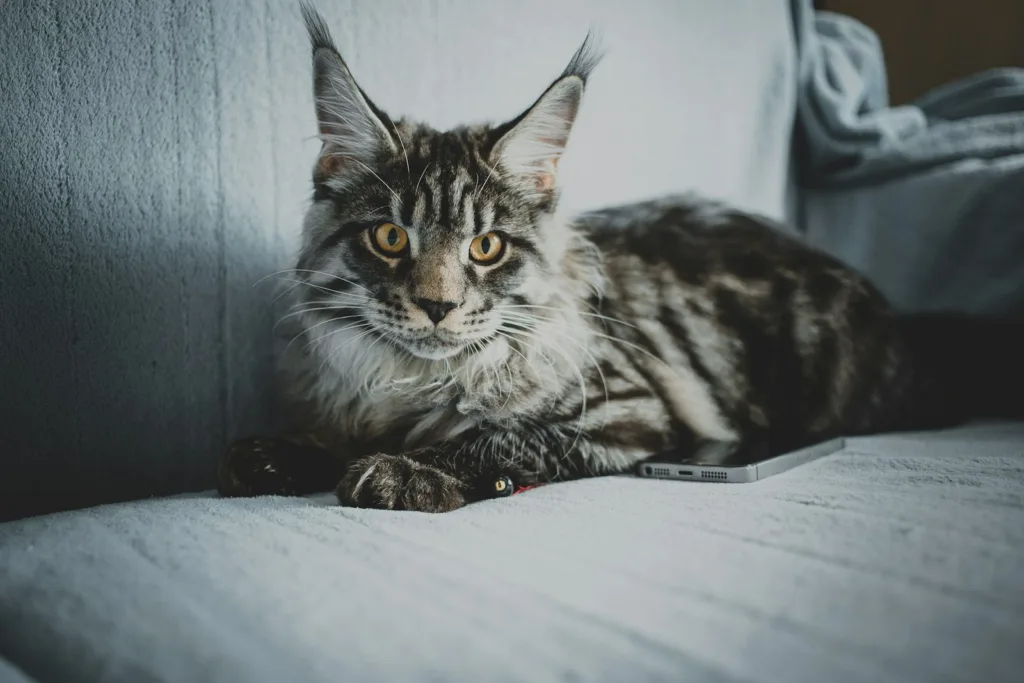
“Tabby Maine Coon” describes a coat pattern, not a breed. A Maine Coon can be tabby, but so can millions of non-pedigreed cats. The classic brown tabby look is strongly associated with Maine Coons because it highlights the breed’s rugged coat, facial markings and long ringed tail.
Registry standards recognize several tabby patterns and many color combinations. The pattern tells you what the coat looks like; the pedigree tells you whether the cat is a Maine Coon.
Is a tabby Maine Coon a separate type of Maine Coon?
No. Tabby is one of the coat-pattern families that occur within the Maine Coon breed. A tabby Maine Coon has the same breed standard for body, head, ears, paws and temperament as other Maine Coons.
Color and pattern sit on top of that basic breed structure.
What is a brown tabby Maine Coon?
A brown tabby Maine Coon has a warm brown ground color with dark, often black, tabby markings. CFA describes the brown tabby ground color as coppery brown with dense black markings.
The exact visual effect depends on whether the pattern is classic, mackerel or ticked, plus the amount of white spotting if present.
Classic vs mackerel vs ticked tabby
| Pattern | What it looks like | Easy visual clue |
|---|---|---|
| Classic tabby | Broad swirls and blotches | “Bullseye” style side pattern |
| Mackerel tabby | Narrow vertical stripes | Fish-bone-like striping along the sides |
| Ticked tabby | Individual hairs banded with color; body pattern reduced | Face and legs show more obvious tabby markings than torso |
CFA’s current Maine Coon standard lists classic, mackerel and ticked tabby patterns. Other registries may organize pattern terminology somewhat differently.
Why do tabby cats have an M on the forehead?
The dark “M” is part of the normal tabby facial pattern created by pigment distribution. It is not unique to Maine Coons and does not prove breed ancestry.
Folklore has supplied many stories about the M. Genetics supplies the less poetic answer: tabby patterning is controlled by inherited pigment-pattern pathways.
The genetics behind tabby pattern
The agouti system controls whether hairs show alternating bands of lighter and darker pigment, while other genes influence the arrangement of the visible tabby pattern. Research has linked variation in the gene TAQPEP to major domestic-cat tabby pattern differences.
That biology is more complicated than “one gene equals one stripe.” Color genes, pattern genes, white spotting and modifiers combine to create the finished coat.
Blue, cream, silver and other tabby Maine Coons
“Tabby” can sit on many underlying colors.
- Blue tabby: diluted black pigment creates blue-gray markings.
- Cream tabby: diluted red produces pale cream markings.
- Silver tabby: an inhibitor effect suppresses warm pigment near the base of the hair, producing a bright silver ground.
- Red tabby: orange/red pigment with visible tabby markings.
- Brown tabby and white: brown tabby pattern plus white spotting.
A “gray Maine Coon” may actually be registered as blue, silver or another specific color depending on the coat.
Tabby Maine Coon vs ordinary tabby cat
A tabby pattern alone cannot identify a Maine Coon. Many domestic longhairs have a brown tabby coat, tufted ears and a fluffy tail.
Look for documented pedigree first. If pedigree is unknown, physical features can support a guess but should not be presented as proof.
| Trait | Maine Coon standard | Domestic tabby cat |
|---|---|---|
| Pedigree | Registered ancestry establishes breed | Usually unknown/mixed ancestry |
| Muzzle | Visibly square | Any shape |
| Body | Long, rectangular, substantial | Highly variable |
| Tail | Long, flowing | Variable |
| Tabby markings | May be classic, mackerel, ticked, etc. | Same patterns can occur |
Does tabby pattern affect personality?
There is no good evidence that a classic tabby Maine Coon has a fundamentally different personality from a black, silver or white Maine Coon because of pattern alone.
People often attach personality stories to coat colors. Treat those as anecdotes unless a specific claim is supported by robust behavioral research.
FAQs
Are all Maine Coons tabby?
No. Maine Coons occur in solid, smoke, silver, tortoiseshell, calico, tabby and many combinations with white.
What is the most common-looking Maine Coon color?
Brown tabby is strongly associated with the traditional Maine Coon appearance, but reliable worldwide color-frequency data are limited.
Does the forehead M mean a cat is a Maine Coon?
No. The M is a normal tabby marking seen across many breeds and mixed-breed cats.
What is a classic tabby Maine Coon?
It is a Maine Coon with broad swirled tabby markings, often including a rounded or bullseye-like pattern on the sides.
Can Maine Coons be ticked tabbies?
Yes under the current CFA Maine Coon standard, which includes ticked tabby pattern descriptions.
Related Maine Coon guides
- Maine Coon Colors and Patterns
- Silver Maine Coon
- Orange Maine Coon
- How to Tell If Your Cat Is a Maine Coon
- Maine Coon breed and care guide
Sources and review
Key reference: Cat Fanciers’ Association: Maine Coon profile and breed standard.
Additional source notes: Cat Fanciers’ Association, Maine Coon breed standard and tabby pattern definitions; The International Cat Association, Maine Coon standard; UC Davis Veterinary Genetics Laboratory, feline coat-color genetics; Kaelin CB, et al. research on feline tabby pattern genetics and TAQPEP..
Editorial fact-check: September 29, 2026.