In this article
A genuine Maine Coon mix has a Maine Coon somewhere in its recent ancestry. In everyday shelter and online use, though, “Maine Coon mix” often means “large fluffy cat that resembles a Maine Coon.” Those are not the same claim.
Without pedigree information, a known parent, or other reliable ancestry records, it is safer to describe the cat you can see rather than invent a family tree from ear tufts.
What is a Maine Coon mix?
A first-generation mix would have one Maine Coon parent and one parent from another breed or the random-bred domestic population. Later-generation descendants can inherit only some Maine Coon-like traits.
Because cats receive a shuffled set of genes from each parent, a mix does not become “50% Maine Coon in appearance.” One sibling may inherit a longer coat and bigger frame; another may look far more like the other parent.
Why many “Maine Coon mixes” are domestic longhairs
Domestic longhair is not a breed. It simply describes a longhaired cat without a documented purebred pedigree.
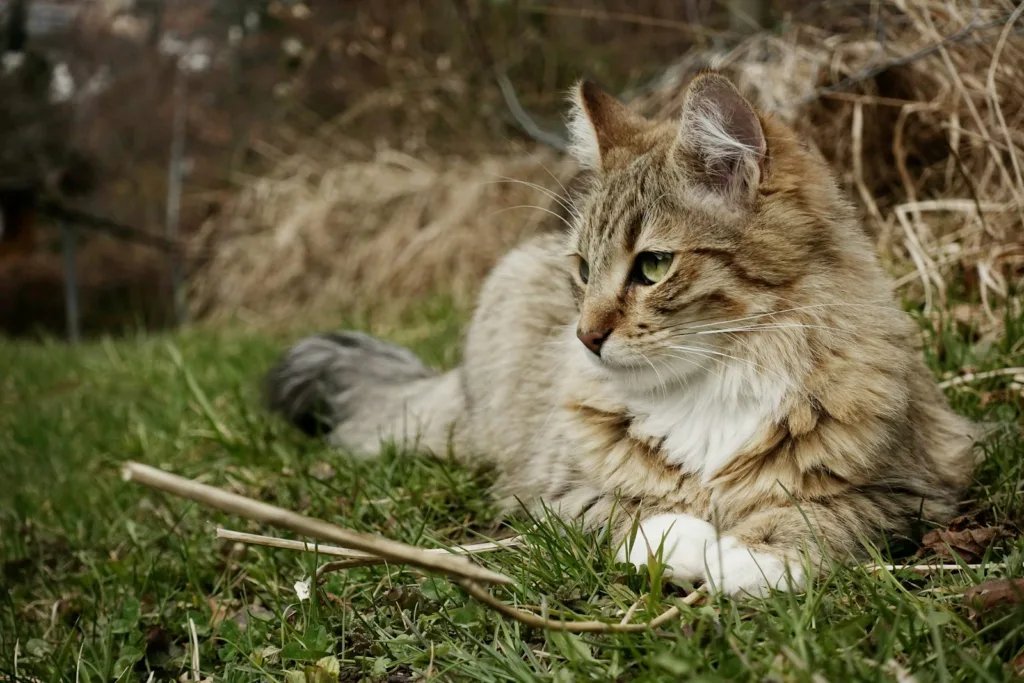
Large body size, a ruff, toe tufts, a bushy tail and tabby markings all occur outside the Maine Coon breed. A shelter may use “Maine Coon mix” as a visual description, but that label should not be treated as proof of ancestry.
Traits a Maine Coon mix may inherit
| Trait | Could be inherited? | How useful for identification? |
|---|---|---|
| Large body | Yes | Low to moderate; many cats can be large |
| Semi-long coat | Yes | Low; common in domestic longhairs |
| Square muzzle | Yes | Moderate when combined with other traits |
| Large furnished ears | Yes | Moderate |
| Long bushy tail | Yes | Low to moderate |
| Social/playful temperament | Yes | Low; behavior is not breed proof |
| HCM-associated A31P variant | Possible if inherited from Maine Coon ancestry | Genetic health testing can detect the variant, but absence does not rule out ancestry |
How big do Maine Coon mixes get?
There is no standard size. A first-generation cross can land anywhere between or beyond the parents’ typical ranges because body size is polygenic and individual.
Do not assume a mixed cat must become huge. A 10-pound adult can have Maine Coon ancestry, and a 17-pound domestic longhair can have none.
Common claimed Maine Coon crosses
Maine Coon tabby mix
This phrase is often confused because “tabby” is a pattern, not a breed. A purebred Maine Coon can already be tabby. A domestic tabby can be mixed with a Maine Coon, but the wording alone tells you nothing about pedigree.
Maine Coon × Ragdoll
A deliberate cross could produce a large, semi-longhaired cat with variable color, coat texture and temperament. It is not a recognized new breed simply because the parents are recognizable breeds.
Maine Coon × Bengal
This cross is sometimes advertised online, but traits are unpredictable. Bengal ancestry can affect pattern and activity; Maine Coon ancestry can affect frame and coat. Marketing names do not make the outcome standardized.
Maine Coon × Norwegian Forest Cat or Siberian
These longhaired northern-looking breeds can produce kittens that are visually difficult to assign by appearance alone. Pedigree records matter far more than a photo comparison.
How to tell if your cat is part Maine Coon
Start with known history. Was one parent a registered Maine Coon? Is there breeder paperwork? Was the litter documented?
If none of that exists, look at traits only as clues. A long rectangular body, square muzzle, large furnished ears and shaggy coat together are more suggestive than a single “M” on the forehead.
Read our How to Tell If Your Cat Is a Maine Coon for the details.
What can cat DNA tests prove?
Consumer breed tests use proprietary reference panels and statistical matching. They can be interesting and may identify genetic health variants, but breed estimates can differ by company and database.
A DNA result should not be treated as equivalent to registry pedigree papers. For an undocumented cat, the most defensible wording is usually “DNA test estimated Maine Coon ancestry” rather than “DNA proved my cat is purebred.”
FAQs
What is a Maine Coon mix?
A cat with Maine Coon ancestry and ancestry from another breed or random-bred domestic cats.
How big do Maine Coon mixes get?
There is no fixed range. Adult size depends on both parents and the genes inherited by that individual kitten.
Is my cat part Maine Coon?
It may be, but appearance cannot prove it. Known parentage or documented pedigree history is stronger evidence.
What is a Maine Coon tabby mix?
Usually it means a cat claimed to have Maine Coon ancestry and a tabby coat. Tabby itself is a pattern, not a separate breed.
Related Maine Coon guides
- Maine Coon Size and Weight
- Maine Coon Cat Breed Guide
- Tabby Maine Coon
- Maine Coon vs Norwegian Forest Cat
Sources and review
Key reference: Cat Fanciers’ Association: Maine Coon profile and breed standard.
Additional source notes: CFA Maine Coon standard; TICA, Maine Coon; UC Davis Veterinary Genetics Laboratory.
Editorial fact-check: September 29, 2026.