In this article
- What is a black Maine Coon?
- Solid black vs black smoke vs black tabby
- What do black Maine Coon kittens look like?
- Why does a black Maine Coon look brown in sunlight?
- Are black Maine Coons rare?
- How big is a full-grown black Maine Coon?
- Black and white Maine Coons
- FAQs
- Related Maine Coon guides
- Sources and review
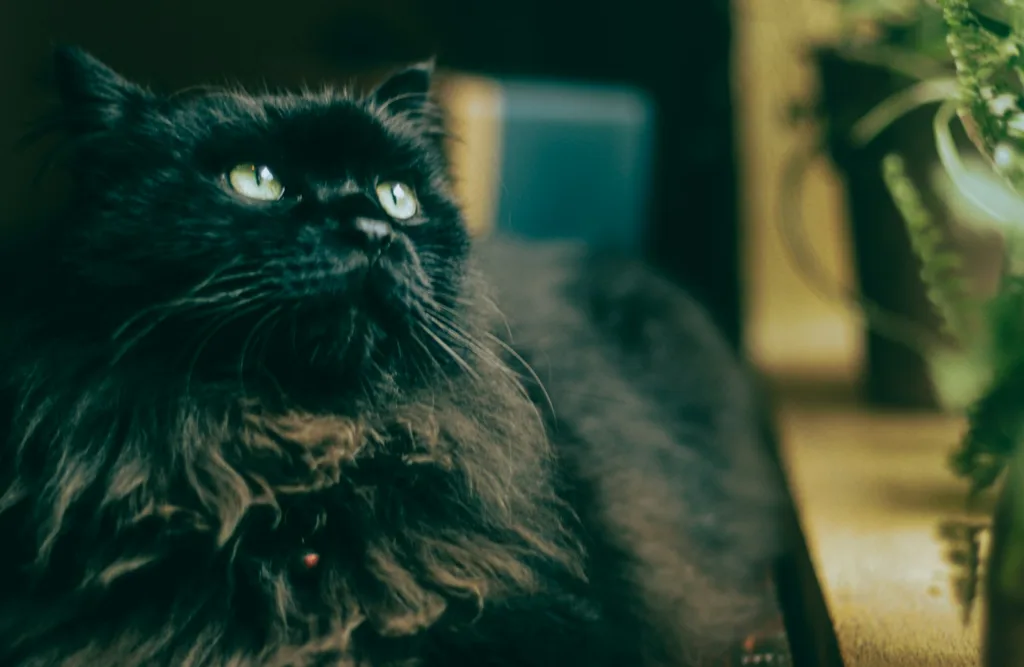
A solid black Maine Coon should read as black through the coat, without a pale smoke undercoat or a clearly expressed tabby pattern. Black smoke can look almost solid from across the room, but when the coat moves or is parted, the hair base is pale or silver.
Color does not create a different size or personality type. A black Maine Coon is a Maine Coon first and a color description second.
What is a black Maine Coon?
In feline color genetics, solid black occurs when the cat produces dark eumelanin and the non-agouti state suppresses the usual tabby pattern enough to create a self-colored coat.
Kittens can show faint “ghost” tabby markings that fade as the adult coat develops. Strong permanent tabby patterning indicates a tabby rather than a solid black.
Solid black vs black smoke vs black tabby
| Type | Hair base | Visible pattern | First impression |
|---|---|---|---|
| Solid black | Dark to roots | No clear adult tabby pattern | Uniform black |
| Black smoke | Pale/silver base, black tips | Usually no tabby pattern as the defining feature | Black until coat parts |
| Black tabby | Banded/agouti hairs | Stripes, swirls or spots | Pattern clearly visible |
Read our Black Smoke Maine Coon for the details.
What do black Maine Coon kittens look like?
A kitten coat can be softer, less even and more prone to visible ghost markings. Adult guard hairs and coat length develop with age, so color may look deeper and more uniform later.
Smoke can also become easier to recognize as the coat lengthens and the pale base becomes visible when the fur moves.
Why does a black Maine Coon look brown in sunlight?
Black coats can develop a rusty or brownish cast from sun exposure, coat wear or normal pigment variation. Nutrition and health can also affect coat quality, so a sudden major change deserves a broader look rather than a color-genetics explanation alone.
A warm cast in summer light does not automatically mean the cat is genetically brown or chocolate.
Are black Maine Coons rare?
Black is an accepted Maine Coon color, and there is no reliable breed-wide census proving it is exceptionally rare. It may be less common in some catteries because tabbies, silvers, smokes or other patterns are more heavily bred or marketed.
“Rare” is often used as a sales adjective. Ask for health records before paying more for vocabulary.
How big is a full-grown black Maine Coon?
Color does not change the breed’s size range. Use the same body-condition and growth guidance that applies to any Maine Coon.
Read our Maine Coon Size and Weight for the details.
Black and white Maine Coons
A black-and-white Maine Coon combines black pigment with white spotting. Depending on distribution, people may casually call the look tuxedo, bicolor or another descriptive term, while registries use more formal class definitions.
FAQs
Are black Maine Coons rare?
Solid black is a recognized color, but there is no authoritative breed-wide frequency table showing that it is exceptionally rare.
How can you tell black from black smoke?
Part the coat. A smoke coat has a pale or silvery base beneath the black tips; a solid black coat remains dark toward the roots.
Why does my black Maine Coon look brown?
Sun exposure and normal coat weathering can create a rusty cast. Persistent coat-quality changes can also have health or nutrition causes.
Related Maine Coon guides
Sources and review
Key reference: Cat Fanciers’ Association: Maine Coon profile and breed standard.
Additional source notes: CFA Maine Coon color codes; TICA, Maine Coon; UC Davis VGL, Feline Coat Color.
Editorial fact-check: September 29, 2026.