In this article
- What is a mitted Ragdoll?
- What is a bicolor Ragdoll cat?
- How do you check a cat without overinterpreting a photo?
- Is bicolor the same as having two colors?
- What about van and high-white cats?
- Does a mismark mean there is something wrong with the cat?
- How is a mitted Ragdoll different from a Birman?
- Frequently asked questions
The face is a useful starting point for telling a bicolor Ragdoll cat from a mitted one, but it should not be the only place you look. Check the chin, front paws, hind legs and underside together.
Both descriptions concern white markings. Neither tells you whether the underlying color is seal, blue, chocolate or something else.
What is a mitted Ragdoll?
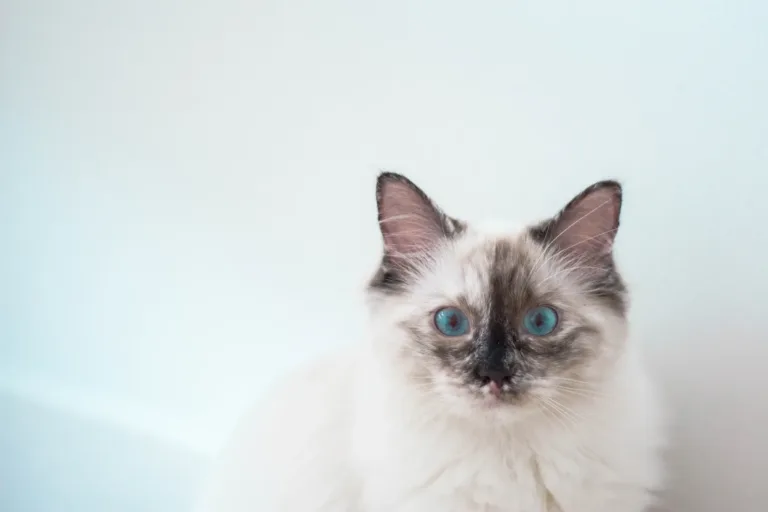
“Mitted” refers to a defined white pattern, including front mittens, white on the hind feet and legs, and a white chin and underside marking. The TICA breed-group standard gives the precise show description and allowances.
A facial blaze can occur, so white somewhere on the nose is not enough to declare a cat bicolor. The arrangement of several features matters more than one isolated patch.
What is a bicolor Ragdoll cat?
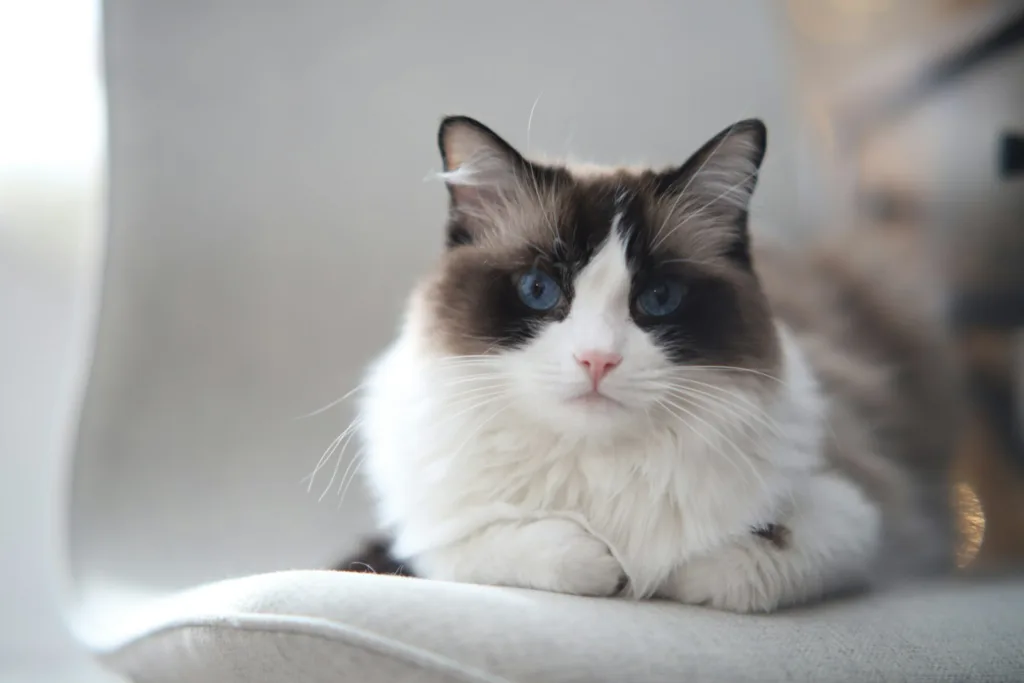
Bicolor has more extensive white, with the inverted V on the face as a prominent feature. This differs from the darker facial mask typically associated with the mitted pattern.
Show standards describe an ideal while also specifying allowances and faults. Real cats may have uneven markings or spots that make an informal identification less straightforward.
| Area | Mitted starting point | Bicolor starting point |
|---|---|---|
| Face | Darker mask; a blaze may be present | Inverted white V |
| Chin | White | Within the more extensively white lower face |
| Front paws | White mittens | More extensive white on the legs |
| Hind legs | White boots extending higher than the front mittens | Predominantly white legs in the standard pattern |
| Underside | Characteristic white stripe | Broader white distribution |
Use this table as an orientation, not a substitute for the relevant registry’s full standard or the cat’s records.
How do you check a cat without overinterpreting a photo?
Start with a front-facing photograph in ordinary light. Then look at standing side views and, only if the cat is comfortable, the paws and underside. Do not restrain a cat into an uncomfortable position to complete a color investigation.
Ask for multiple images if you are considering a kitten. A sleeping cat with all four paws tucked away is providing very little assistance to the identification process.
Young coats and extensive white can obscure details. If the seller’s description matters to the purchase, ask what is recorded rather than relying on your own provisional visual assessment.
Is bicolor the same as having two colors?
Not in this context. The term refers to a particular white pattern, not simply the number of shades you can count.
A blue bicolor Ragdoll and a seal bicolor Ragdoll share a pattern description while differing in color. A lynx or tortie overlay adds another part to the name.
The colors and patterns guide explains that layered naming system.
What about van and high-white cats?
CFA includes a van description in its Ragdoll standard. Do not assume every registry organizes high-white cats in exactly the same way or that every mostly white cat is correctly described as van.
Ask which standard is being used. A seller’s informal “high white” label and a registry’s category may not be identical.
The white Ragdoll guide distinguishes high-white patterns from pale kittens and genuinely all-white adults.
Does a mismark mean there is something wrong with the cat?
A marking that does not match the show ideal is not, by itself, a medical defect. It may affect show assessment while having no bearing on the cat’s suitability as a companion.
Health still needs its own evaluation. Neither unusually tidy markings nor an expensive show label replaces records, veterinary care or a suitable upbringing.
If a seller uses “pet quality,” ask what specifically they mean. The explanation should be clearer than “not quite symmetrical enough,” and it should not obscure any actual health concern.
How is a mitted Ragdoll different from a Birman?
Both may have white feet, but the breed standards describe different combinations of markings and structure. Birman gloves and rear laces are part of that breed’s description; white paws alone cannot identify ancestry.
Use the Ragdoll versus Birman comparison when choosing between the breeds. If you are trying to identify a rescue cat, its history may be more useful than treating its socks as paperwork.
Frequently asked questions
Can a mitted Ragdoll have a white blaze?
Yes, a blaze can be part of the described pattern. Its presence alone does not make the cat bicolor.
Are all bicolor Ragdolls identically marked?
No. Individual variation exists, and show standards specify how markings are assessed.
Are mitted cats always seal-colored?
No. Mitted describes the white pattern and can accompany different colors.
Which pattern is healthier or friendlier?
The reviewed evidence does not support choosing between mitted and bicolor on that basis. Assess the individual’s health and behavior.