In this article
- Why do young Ragdoll kittens look white?
- Which kind of “white” are you looking at?
- Are all-white adult Ragdolls accepted by registries?
- Is van the same as all white?
- Could a “white Ragdoll” actually be cream?
- Are white Ragdolls deaf?
- What should you ask before buying or adopting?
- Frequently asked questions
“White Ragdoll” can describe several different appearances: a pale young pointed kitten, a cat with extensive white markings, a cream-point cat with faint contrast or an adult whose coat is genuinely all white. Those situations should not be treated as interchangeable.
The reviewed Ragdoll show standards describe pointed cats, and the current TICA Ragdoll/Cherubim standard excludes solid white. That is a statement about the standard—not a DNA test proving that every white adult has mixed ancestry.
Why do young Ragdoll kittens look white?
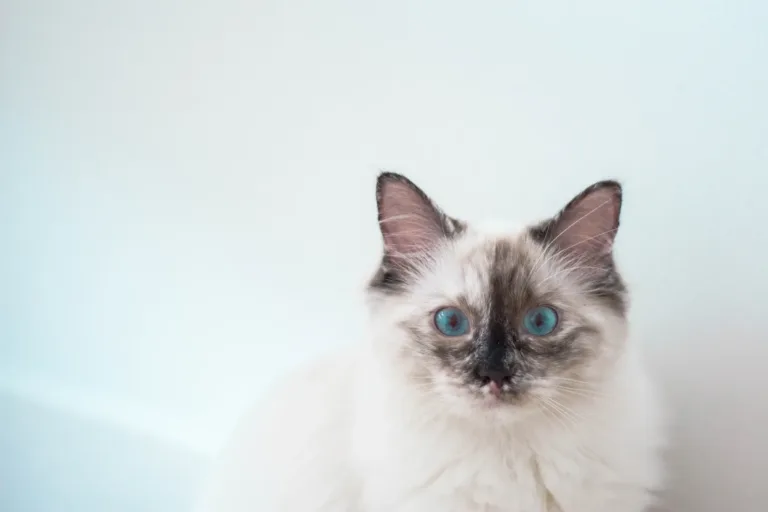
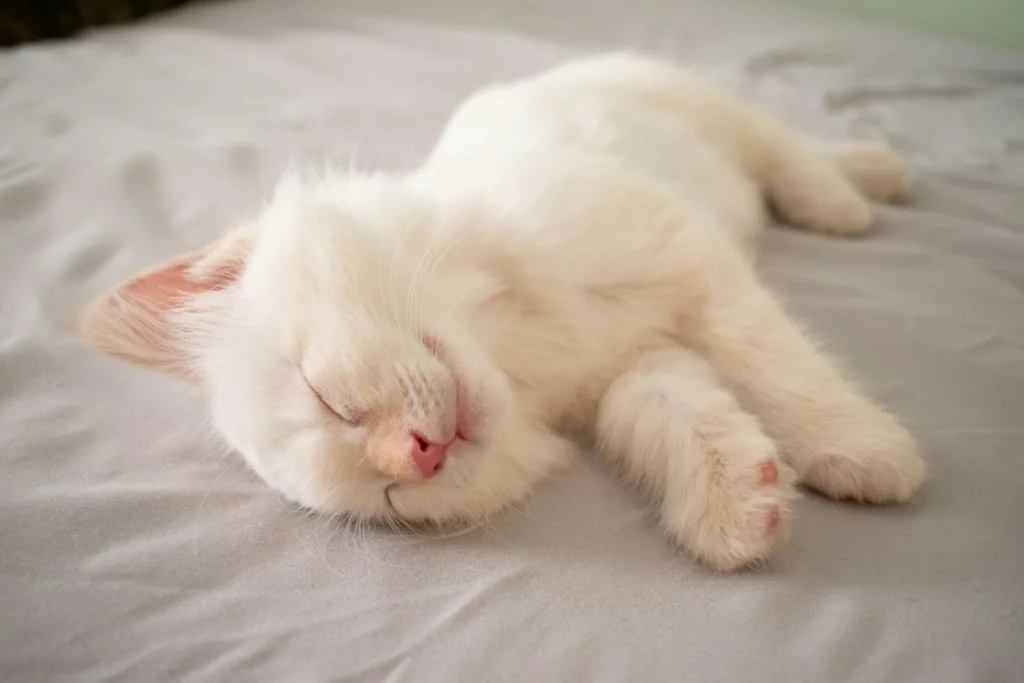
Pointed coloration involves temperature-sensitive pigment production. Very young pointed kittens can appear white or extremely pale before their points become more visible.
As color develops, the ears, face, tail and other cooler areas may show increasing contrast. The timing and visible intensity vary, so an early photograph cannot promise the exact adult shade.
This explanation applies to pointed development. It should not be stretched into a claim that every pale kitten of unknown ancestry is a Ragdoll.
Ask for dated photographs and the recorded color description. The color and pattern guide explains the underlying terms before you compare listings.
Which kind of “white” are you looking at?
| Appearance | Possible explanation | Useful next step |
|---|---|---|
| Very pale young kitten | Point color is still developing | Review age, records and dated photos |
| White body areas with colored ears, tail or face | A substantial white pattern | Check the formal pattern description |
| Nearly white coat with faint warm points | Pale cream coloration may be involved | Compare unfiltered photos and registration wording |
| Adult that appears entirely white | A different genetic or descriptive question from ordinary visible points | Review records and relevant testing; do not guess ancestry |
| Gray and white longhaired cat | Many possible color and ancestry combinations | Describe appearance separately from pedigree |
The table is a way to organize questions, not diagnose a coat genotype. Bright lighting can erase faint detail, so “I cannot see points in this picture” is different from “this adult is genetically solid white.”
Are all-white adult Ragdolls accepted by registries?
The reviewed standards do not support the blanket claim that an all-white adult meets the ordinary Ragdoll show description. The TICA standard effective May 1, 2025 places pointed, blue-eyed Ragdolls and the Cherubim categories in the same breed group while excluding solid white.
CFA’s reviewed Ragdoll standard also describes a pointed breed, with defined colors and white patterns. A large amount of white in an accepted pattern is not the same thing as a completely white adult coat.
Registration, pedigree ancestry and show eligibility are related but distinct questions. Ask exactly what claim a seller is making, which registry is involved and what documentation supports it.
It would be equally careless to answer an inaccurate “all white is accepted everywhere” claim with “every all-white adult must be a mix.” Coat appearance alone cannot settle that ancestry question.
Is van the same as all white?
No. A high-white pattern can retain colored areas even when much of the body is white. CFA’s Ragdoll standard includes a van pattern description; it is not permission to replace the pointed-color requirements with an entirely white cat.
Informal phrases such as high-white bicolor may also appear in listings. Ask for the formal recorded pattern rather than assuming that informal wording maps identically across registries.
For related white-pattern questions, the bicolor and mitted guide explains why white feet, a white face or a white body cannot independently identify the complete pattern.
Could a “white Ragdoll” actually be cream?
Yes, a pale cream-point cat may appear nearly white in some photographs. Cream is diluted red, and its subtle points can be especially difficult to assess in a young kitten.
That is one possible explanation, not a conclusion to impose on every white-looking cat. Ask for natural-light views of the ears, tail and face and check the records.
The red and cream guide explains the color family without treating camera exposure as genetic evidence.
Are white Ragdolls deaf?
Do not infer hearing from a color label or photograph. Cornell Feline Health Center explains an association between congenital deafness and white cats, particularly some white cats with blue eyes, but that does not mean every white, blue-eyed cat is deaf.
It also does not justify applying a general white-cat percentage to pale pointed Ragdoll kittens. A young pointed coat, extensive white pattern and the genetic causes of an all-white coat are not one interchangeable category.
If you suspect hearing loss, ask a veterinarian about assessment and whether objective testing such as BAER is appropriate. A cat’s response to a household noise is not a complete hearing examination.
Do not confuse the association with a claim that blue-eyed cats are inevitably blind. Eye color by itself does not establish vision loss.
What should you ask before buying or adopting?
Ask the cat’s age, its formal recorded color and pattern, and whether the claimed pedigree is documented. If testing is mentioned, request the actual report and an explanation of what it can and cannot show.
Health and household fit still matter more than a striking description. Review veterinary records, hearing concerns if present, grooming needs and the cat’s behavior.
The adoption and breeder guide provides a broader checklist. A “rare white” label should not make ordinary questions disappear.
Frequently asked questions
Are there all-white Ragdolls?
Some cats are marketed that way, but the reviewed Ragdoll standards do not support an entirely white adult show coat. Check the actual records and distinguish show eligibility from ancestry.
Why is my Ragdoll kitten white?
A young pointed kitten may be very pale before point color develops. Age, photographs and the recorded color description help clarify what you are seeing.
Will a white-looking kitten stay white?
Not necessarily. Pointed kittens can develop more visible color, but no single early photograph guarantees the final shade or pattern.
Does a white coat with blue eyes mean my cat is deaf?
No. There is an association in some white-cat populations, not a universal diagnosis. Ask a veterinarian to assess any hearing concern.
Is a gray-and-white longhaired cat automatically a Ragdoll?
No. Those features occur in many cats. Pedigree claims require documentation rather than appearance alone.