In this article
- What does a chocolate Ragdoll look like?
- What makes chocolate different genetically?
- Chocolate versus seal versus cinnamon
- What are chocolate point, mitted and bicolor?
- Does a chocolate kitten stay the same shade?
- Are chocolate Ragdolls rare?
- Does chocolate coloring change temperament or care?
- Frequently asked questions
A chocolate Ragdoll is not simply any Ragdoll that looks brown. Chocolate is a specific color term, distinct from seal and cinnamon, even though all three can be described casually as shades of brown.
That distinction matters when you compare listings or ask what a kitten may look like as an adult. “Brown” can describe your impression accurately while still leaving the genetic color unresolved.
What does a chocolate Ragdoll look like?
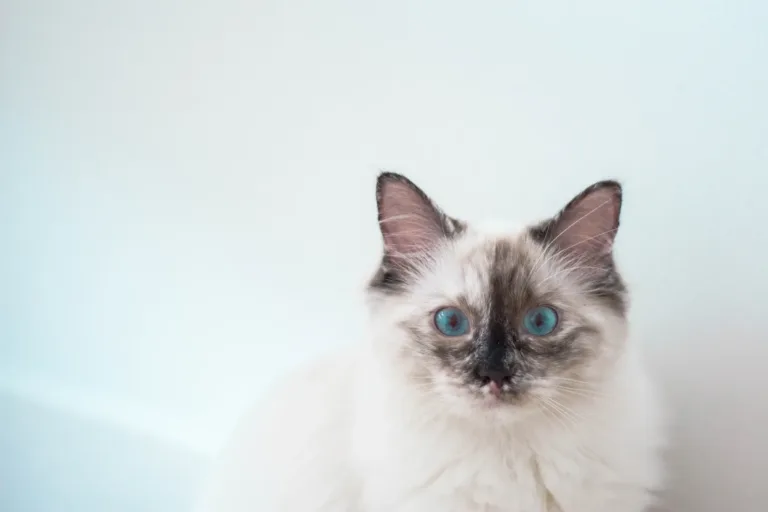
Standard descriptions refer to warm milk-chocolate points against a lighter body. The depth of the visible color, the amount of white and the lighting can all affect that impression.
White-pattern features belong to another part of the name. A chocolate bicolor and a chocolate colorpoint need not have similarly colored faces, because the bicolor’s white can cover areas that would otherwise show the point color.
The Ragdoll colors and patterns guide explains how those descriptions fit together.
What makes chocolate different genetically?
The UC Davis Veterinary Genetics Laboratory brown test describes the TYRP1 variants behind chocolate and cinnamon. In simplified notation, chocolate can be expressed as b/b or b/bˡ, whereas cinnamon is bˡ/bˡ.
The ordinary black-based pigment behind seal is genetically distinct from chocolate. This is why “chocolate seal point” should not be accepted as a precise synonym without clarification.
You do not need to memorize the notation to buy or adopt a cat. You do need to understand that a warm brown photograph cannot independently resolve all those possibilities.
Chocolate versus seal versus cinnamon
| Term | Useful distinction | Common mistake |
|---|---|---|
| Seal | A deep, darker brown point color | Calling every brown point chocolate |
| Chocolate | A separate brown-locus color | Treating it as a light exposure setting for seal |
| Cinnamon | A different variant at the same locus | Calling it diluted chocolate |
| Lilac | Diluted chocolate | Assuming it is simply a pale blue cat |
The seal point guide and cinnamon guide cover their own identification and registry questions.
When comparing photos, look for similar lighting and image processing. A beige sofa, a warm bulb and an enthusiastic filter can make the task much harder than it needs to be.
What are chocolate point, mitted and bicolor?
These combine the chocolate color with different white distributions. Mitted and bicolor describe where white appears; they do not create a new brown pigment.
A chocolate lynx description adds tabby features. Chocolate tortie involves the additional patchwork color description. Several terms can therefore appear in the same cat’s recorded name.
Use our pattern comparison to understand those markings. Avoid judging color solely from a nose or paw pad where white spotting changes the expected appearance.
Does a chocolate kitten stay the same shade?
Pointed cats develop contrast as they mature, and an early pale appearance may not represent the adult coat. Ask for dated photographs of the same cat and for the breeder’s recorded color determination.
Progress photographs can be informative without being a guarantee. The parents’ appearance also does not let you predict an exact finished shade on a particular kitten.
If certainty about the color is important, ask whether relevant genetic testing has been performed. Keep that result separate from pedigree verification: a color report does not identify every ancestor.
Are chocolate Ragdolls rare?
Availability varies between breeding programs, but the evidence reviewed for this article does not provide representative counts that support an exact rarity ranking. “We rarely produce this color” is a statement about one program, not necessarily the whole breed.
Likewise, there is no universal chocolate premium established here. Compare the total quote, included care and records using the Ragdoll price guide.
Ask why a price differs before assuming the explanation is rarity. A longer color name does not automatically mean more veterinary care was provided.
Does chocolate coloring change temperament or care?
There is no established chocolate-specific personality in the evidence reviewed. Assess handling tolerance, activity and social behavior in the individual.
Regular grooming, suitable feeding and veterinary care remain more relevant to daily life than the exact brown shade. Choose a color you enjoy, but keep the questions about the cat’s actual needs at the center of the decision.
Frequently asked questions
Are brown Ragdolls real?
Brown is a reasonable everyday description, but it may refer to different formal color categories. Ask for clarification if genetics or registration matters.
Is chocolate the same as seal point?
No. They are distinct color terms, even though both can look brown.
What is the dilute version of chocolate?
Lilac. Our lilac Ragdoll guide explains how it differs from blue.
Can a chocolate Ragdoll be mitted or bicolor?
Yes. Color and white pattern describe different features.
Can I confirm chocolate from a photograph?
A photograph can support a description but may not settle an uncertain identification. Records and appropriate color testing provide different kinds of evidence.