In this article
- Mink Ragdoll vs. Cherubim: What Does TICA Recognize?
- What do pointed, mink, sepia and full color mean genetically?
- Is mink a color like blue or chocolate?
- Are black and tuxedo Ragdolls real?
- Can eye color settle the question?
- Do these categories prove recent Burmese or Siamese ancestry?
- What should a buyer ask?
- Frequently asked questions
“Mink Ragdoll” remains a common search term, but the label needs current registry context. TICA’s May 2025 standard places Ragdoll and Cherubim in the same breed group while distinguishing their color categories.
That makes “all such cats are fake” unhelpful. So is “all of them are the same registered breed.” Ask what the cat looks like, what its records establish and what the named registry calls it.
Mink Ragdoll vs. Cherubim: What Does TICA Recognize?
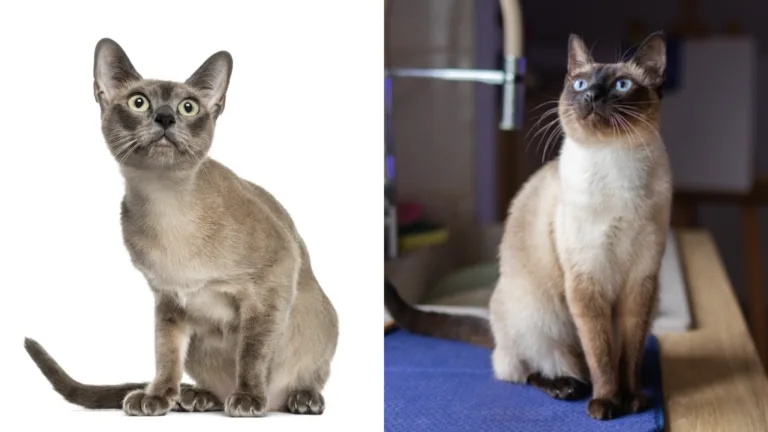
The TICA Ragdoll breed-group standard identifies Ragdolls as pointed cats and Cherubim in mink, sepia and traditional color categories. It also specifies eye-color expectations for those categories and excludes solid white.
CFA’s Ragdoll standard follows its own pointed color descriptions. A TICA category should not be assumed to apply identically in CFA or another association.
These distinctions concern registration and showing terminology. A description in a sales listing is not the same as an issued pedigree.
What do pointed, mink, sepia and full color mean genetically?
UC Davis Veterinary Genetics Laboratory explains the relevant TYR color-restriction variants. A simplified comparison is useful:
| Category | Simplified genetic notation | Broad pigment-distribution distinction |
|---|---|---|
| Pointed | cˢ/cˢ | Greater contrast between points and body |
| Mink | cᵇ/cˢ | Intermediate restriction |
| Sepia | cᵇ/cᵇ | Less pronounced point-to-body contrast |
| Full color | At least one dominant C allele | Color is not restricted in the same way |
A dominant full-color allele can mask a recessive restriction allele. Therefore, a visibly solid cat may still carry a point allele; “solid cats never carry colorpoint” is incorrect.
This table simplifies one part of coat genetics. It does not describe every gene affecting the appearance, and it cannot establish breed ancestry by itself.
Is mink a color like blue or chocolate?
It describes a different layer of the coat’s genetics and appearance. Blue, seal and chocolate identify pigment color; mink concerns how that pigment is distributed.
That is why combined descriptions can occur. It is also why “mink sepia” should not be used as though the terms are interchangeable alternatives for a dark-looking cat.
The Ragdoll colors and patterns guide explains the other layers, including white markings and lynx or tortie features.
Are black and tuxedo Ragdolls real?
Black and black-and-white cats certainly exist. “Tuxedo” is an everyday description of a black-and-white appearance, not a pedigree certificate or a precise answer about registry status.
If a seller uses “black Ragdoll,” ask what appears on the registration documents and whether the description relates to Cherubim, another registry’s rules or an informal ancestry claim. Do not conclude that every black longhaired cat is a Ragdoll mix.
For unknown-parentage cats, our mixes and identification guide explains the limits of photographs and consumer breed-similarity testing.
Can eye color settle the question?
Eye color contributes to a standard description, but it is not a stand-alone ancestry test. A green-eyed cat should not automatically be declared a mix without examining the relevant category and records.
Photographs can also distort eye color. Ask for documentation when the distinction affects a purchase or a showing plan; an argument conducted entirely through filtered photographs is unlikely to improve the paperwork.
Do these categories prove recent Burmese or Siamese ancestry?
No. Sharing a color-restriction allele does not, by itself, identify a recent ancestor or the timing of a cross. Historical pedigree questions require evidence beyond the coat genotype.
Avoid confident claims about a particular breeder’s cats without the records. It is reasonable to ask for clarity; it is not reasonable to manufacture a family tree from a single test result.
What should a buyer ask?
- What exact breed and color category will appear on the papers?
- Which registry issues those papers, and can the information be verified?
- Are the kitten and parent identities consistent across the documents?
- What health testing and veterinary care are documented?
- Does the written contract match the description in the advertisement?
Apply the same scrutiny to a traditional pointed kitten. Familiar terminology is not proof of better care.
Price should also be considered separately. Our Ragdoll cost guide shows why a rare-sounding label is not evidence of a justified premium.
Frequently asked questions
Is a mink cat automatically mixed-breed?
No. The visible category alone does not establish ancestry. Check the pedigree and the relevant registry’s classification.
Is Cherubim a derogatory term?
No. It is a named category within TICA’s current breed-group standard. Accurate terminology is useful without making a judgment about a cat’s value as a companion.
Are mink and sepia the same?
No. They have different combinations of the color-restriction variants described above.
Can a solid cat carry a pointed allele?
Yes. A dominant full-color allele can mask a recessive point allele.
Does cinnamon always mean Cherubim?
No. Cinnamon is a color, while the point category is a separate question. See the cinnamon Ragdoll guide for the registry distinction.