In this article
- How to Tell If Your Cat Is a Maine Coon: A Quick Answer
- 10 signs your cat looks Maine Coon-like
- Maine Coon vs domestic longhair
- How do you identify a Maine Coon kitten?
- Can a Maine Coon have short hair?
- The “M” on the forehead myth
- Maine Coon vs tabby
- Can DNA testing prove my cat is a Maine Coon?
- FAQs
- Related Maine Coon guides
- Sources and review
Wondering how to tell if your cat is a Maine Coon? If a cat has registration papers or a documented pedigree, you can verify that it is a registered Maine Coon. Without that paper trail, appearance can suggest Maine Coon-like ancestry, but it cannot prove it.
Consumer DNA tests may estimate breed similarity or ancestry using company-specific reference panels, but they are not equivalent to pedigree registration and should not be treated as a courtroom verdict on breed identity.
How to Tell If Your Cat Is a Maine Coon: A Quick Answer
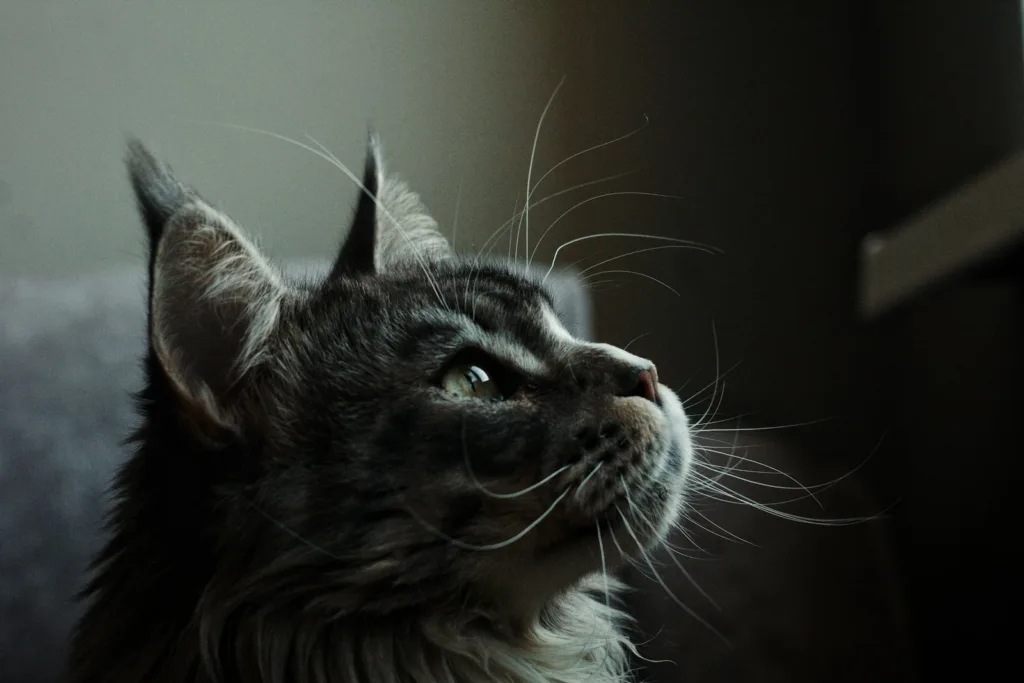
A Maine Coon typically combines several traits: a long rectangular body, substantial bone, a long flowing tail, a shaggy coat, large ears with furnishings, tufted paws and a broad/square-looking muzzle. One trait alone is weak evidence.
10 signs your cat looks Maine Coon-like
Use this as a resemblance checklist, not a breed certificate.
| Trait | Maine Coon tendency |
|---|---|
| Large rectangular body | Long, substantial torso |
| Long bushy tail | Often at least visually proportional to body |
| Large ears | Broad base with strong furnishings |
| Lynx-like ear tips | Can occur, not required as a standalone proof |
| Tufted paws | Hair between toes is common |
| Shaggy uneven coat | Shorter over shoulders, longer on belly/britches |
| Ruff | Often more developed in adults |
| Square muzzle | A key breed-standard feature |
| Slow maturation | Breed often matures around 4 years |
| Social/playful behavior | Commonly described, but not diagnostic |
This is an observation checklist, not a validated identification test. Sharing these features does not establish purebred status or a percentage of Maine Coon ancestry.
Maine Coon vs domestic longhair
| Feature | Maine Coon | Domestic longhair |
|---|---|---|
| Breed status | Defined breed with pedigree standard | Coat-length category, not one breed |
| Body | Typically long and rectangular | Any body type |
| Muzzle | Broad/square tendency | Variable |
| Ears | Large, furnished | Variable |
| Coat | Shaggy, uneven length | Any long-coat texture/pattern |
| Tail | Long and flowing | Variable |
| Size | Typically large | Small to large |
Many shelter cats labeled “Maine Coon mix” are simply large domestic longhairs with some Maine Coon-like traits. That does not make them lesser cats; it just means appearance is not pedigree evidence.
How do you identify a Maine Coon kitten?
Kittens are harder to judge because adult coat, muzzle and body proportions are still developing. Large paws and ears are suggestive but not conclusive.
If breed certainty matters, ask for pedigree/registration documentation from a recognized registry and verify the breeder. A kitten photo cannot replace paperwork.
Can a Maine Coon have short hair?
A purebred Maine Coon is a semi-longhaired breed. A cat with a genuinely short adult coat does not fit the breed standard, although a mixed-ancestry cat could inherit some Maine Coon-like traits without the full coat.
The “M” on the forehead myth
The M-shaped forehead marking belongs to tabby patterning, not the Maine Coon breed. Many non-Maine-Coon tabbies have it, and a solid Maine Coon may not show it.
Maine Coon vs tabby
“Tabby” describes a coat pattern. “Maine Coon” describes a breed. A Maine Coon can be tabby, and a tabby can belong to many breeds or no recognized breed at all.
Can DNA testing prove my cat is a Maine Coon?
Pet DNA companies compare a cat’s markers with their own reference data and may report breed similarity, ancestry components or traits. Results can differ because databases and algorithms differ.
For a registered purebred claim, pedigree records remain the stronger evidence. DNA testing is more useful for genetic traits and disease variants than for turning an undocumented longhair into a formally registered Maine Coon.
FAQs
How can I tell if my cat is a Maine Coon?
Look for a combination of breed-standard traits, but use pedigree documentation to confirm registered purebred status.
Is my cat part Maine Coon?
It is possible, but appearance alone cannot establish ancestry. Consumer DNA tests may offer an estimate rather than definitive proof.
Do Maine Coons have an M on their forehead?
Tabby Maine Coons can. The M is a tabby marking, not a Maine Coon marker.
Is my cat a Maine Coon or a domestic longhair?
Without pedigree documentation, a cat that simply resembles a Maine Coon is more accurately described by its observable traits, such as “large domestic longhair with Maine Coon-like features.”
Related Maine Coon guides
- Maine Coon Mix Cats
- Maine Coon Physical Traits
- Maine Coon Size and Weight
- Maine Coon Growth Chart
- Maine Coon breed and care guide
Sources and review
Key reference: Cat Fanciers’ Association: Maine Coon profile and breed standard.
Additional source notes: CFA Maine Coon breed standard; TICA, Maine Coon; UC Davis VGL, feline genetics resources; Basepaws breed/ancestry methodology information; Wisdom Panel cat DNA information.
Editorial fact-check: September 29, 2026.